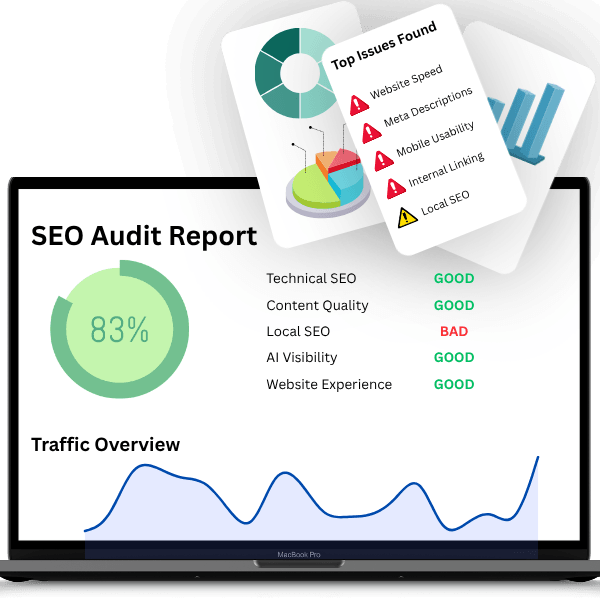

Getting organic traffic and getting business leads are two separate outcomes. A business stops getting leads when these five things break down: the wrong keywords, the landing page fails to build confidence, missing trust signals, weak Local SEO, or no clear path for the visitor to take action. Traffic tells you Google found you. Leads tell you your website convinced someone to contact you. Both need to work together.
Most business owners believe this one: “If people come from Google, enquiries will start coming automatically.”
But in a real business scenario, it does not always work like that.
In my 13+ years of SEO experience, I have seen many business websites getting 1000s of impressions and organic clicks.
Some websites may get decent traffic from Google search, but still, their phone does not ring. Even their WhatsApp stays silent, and enquiry forms remain empty.
This is the moment when business owners think SEO is not working.
If your business is not getting leads from Google, the problem is not Google traffic alone. You need to analyze what kind of traffic is coming, which page they are landing on, and the conversion path.
Check your SEO strategy, website experience, and conversion path. In my previous blog, I explained that businesses struggle to rank on Google. But ranking is only one side of the story.
The other side is, after people land on your website from search, your content, trust signals, and Local SEO presence must work together.
If not, you may get Google traffic but no leads, and this is where the real SEO leads problem begins.
1. Getting Google Traffic Is Not the Same as Getting Leads
It may feel happy when you see impressions, clicks, and visitors in your Google Search Console or Analytics.
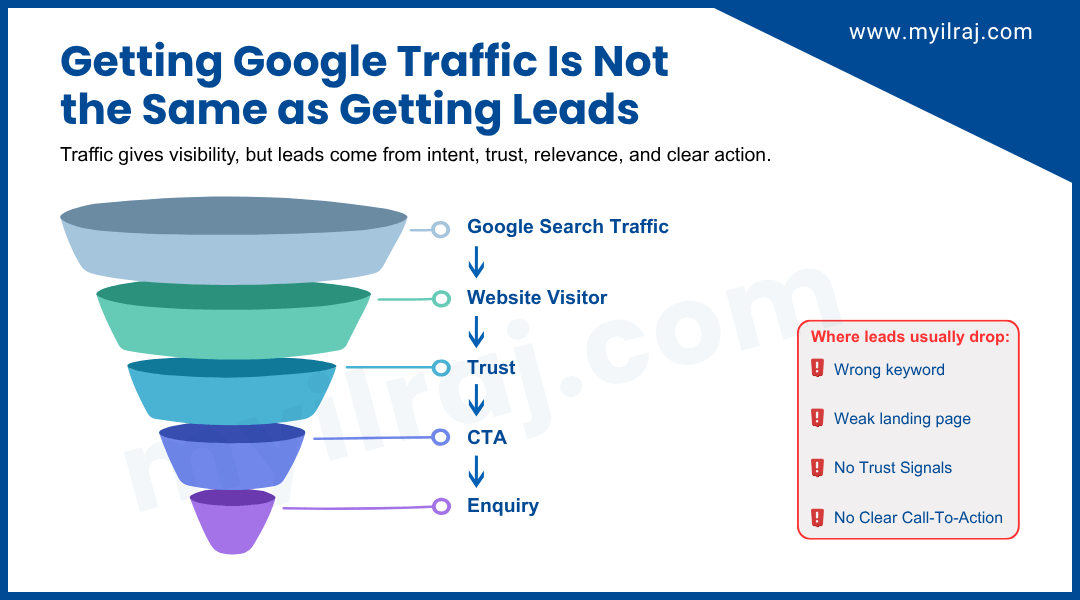
When traffic starts coming, it feels like SEO has started working. But remember that Google traffic and business leads are not the same (directly proportional).
Even though your business websites get organic visitors from Google, they still may fail to generate leads.
Some of the reasons:
- If the right people are not landing on the right pages.
- When the page does not give them enough confidence to contact your business.
Here’s where some websites face the problem of Google traffic but no leads.
Lead generation happens when search intent, page content, trust signals, local relevance, and CTA work together.
Do not blame Google or SEO if your website visitors are not converting. First, check why the website traffic is not becoming enquiries.
Reason 01: Sometimes, the traffic is too informational.
Reason 02: Sometimes, the landing page is weak.
Reason 03: Sometimes, the visitor is interested, but there is no clear step.
Key Takeaway: Traffic gives visibility. Leads come from intent, trust, relevance, and clear action paths.
2. You May Be Targeting the Wrong Keywords
One common reason a business is not getting leads from Google is wrong keyword targeting.
Your website may be ranking on the first page, but it may be ranking for searches that do not bring buyers.
For example, a person searching “What is SEO” is mostly trying to learn.
But someone searching “reliable SEO consultant in Coimbatore” or “Local SEO services near me” is already closer to taking action.
Were you able to understand the difference?
This is where many businesses get confused. They see traffic coming in. But if the keywords are not connected to buying intent, the website may get visitors but no enquiries.
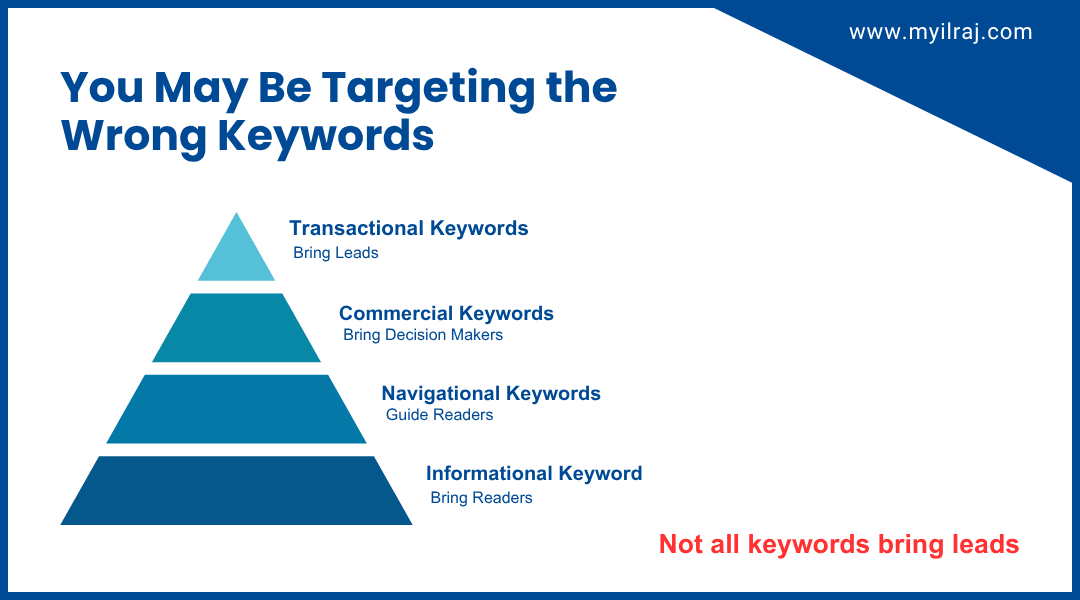
2.1. Informational Keywords Bring Readers
Informational keywords are useful in bringing people who are still learning about a topic. Searches like “what is SEO,” “how Google ranking works,” or “SEO meaning” are good examples.
People who land on your website through these search funnels are not ready to buy your SEO services immediately. They are in the learning phase and trying to understand the basics first.
So, if your website ranks only for such informational keywords, you may see traffic, but no calls or enquiries.
I am not saying informational keywords are bad for SEO.
In fact, these keywords are important in building trust, educating your audience, and improving topical authority. But these keywords do not bring business.
Key Takeaway:
The mistake happens when businesses create only learning-based content and ignore decision-making content.
That means the website will get organic visitors, but they won’t convert.
2.2. Navigational Keywords Guide Readers to Make Decisions
Navigational keywords are used by people who already know your brand, business name, or personal name.
For example, see these keywords below;
- Myilraj G, SEO consultant,
- Myilraj SEO Consultant in Coimbatore,
- Raj Softech Solutions SEO services,
- Myilraj blog.
These people are not searching randomly. They may have seen your LinkedIn post, visited your website earlier, or heard about you from someone.
Sometimes, they may have found your content through Google, and now they are searching specifically to reach you.
This is why branding and SEO should work together. When people start searching your name along with your service, it shows trust and recall.
Key Takeaway:
Navigational keywords may not always bring new visitors, but they bring warm visitors who already have some level of trust.
These searches can convert better when your website, service pages, and contact options are clear.
2.3. Commercial Keywords Bring Decision-Makers
I always say, commercial keywords are more valuable if your goal is lead generation.
These are the search queries where people compare options, check service providers, or try to decide whom to contact.
For example;
See these keywords below;
- SEO consultant for small business,
- Local SEO services in Coimbatore,
- SEO strategy for business growth.
These keywords show stronger business intent. The person searching these terms is probably in the decision stage. Either they want to improve their website visibility or find someone who can help.
This is where your content should guide them properly. Explain the problem, show your approach, build trust, and help them understand why your service is relevant.
Key Takeaway:
Commercial intent keywords need balanced content. The reader wants clarity before making a decision.
If you either write basic blogs or directly push your service page, leads won’t happen.
2.4. Transactional Keywords Bring Leads
These keywords are the real lead generation keywords. People search for these queries when they are ready to take action.
For example, see these keywords below;
- Hire an SEO consultant,
- Book an SEO consultant,
- SEO services for a business website.
When someone searches like this, they may already have a problem and are looking for the right person or SEO agency to solve it.
This is where your landing page, CTA, trust signals, and service clarity become very important.
Check if your website is missing these kinds of transactional keywords properly. This is one major reason why SEO is not generating leads for many businesses.
How do all four keyword types work together?
A strong SEO strategy should not depend on only one type of keyword.
- Informational keywords bring readers.
- Commercial keywords bring decision-makers.
- Transactional keywords bring leads.
When all these three keywords work together, Google traffic becomes much more powerful for your business growth.
3. Your Search Intent May Not Match the Page Content
Sometimes, the keyword may be correct, but the content may not match what the users actually expect. This is what I call a poor search intent match.
For example, if someone searches “SEO consultant vs SEO agency,” they are not looking for a sales pitch.
Rather, they came for comparison, cost differences, pros and cons, practical advice, etc. The visitors are in the decision-making stage.
In such cases, if your page talks about your service, what you do, and then pushes the user to contact you, they may leave the page.
This is a common reason why SEO is not generating leads for many businesses. The page may rank, but it does not satisfy the visitor’s real question.
Digital marketing agencies in Coimbatore want to rank for topics like “digital marketing tips.” The visitors may come from those searches, but only for learning.
They may not become a lead. That’s why I say the website should also target service keywords, comparison keywords, cost-related keywords, and problem-solving keywords.
4. Your Landing Page Is Weak Even If Your SEO Is Working
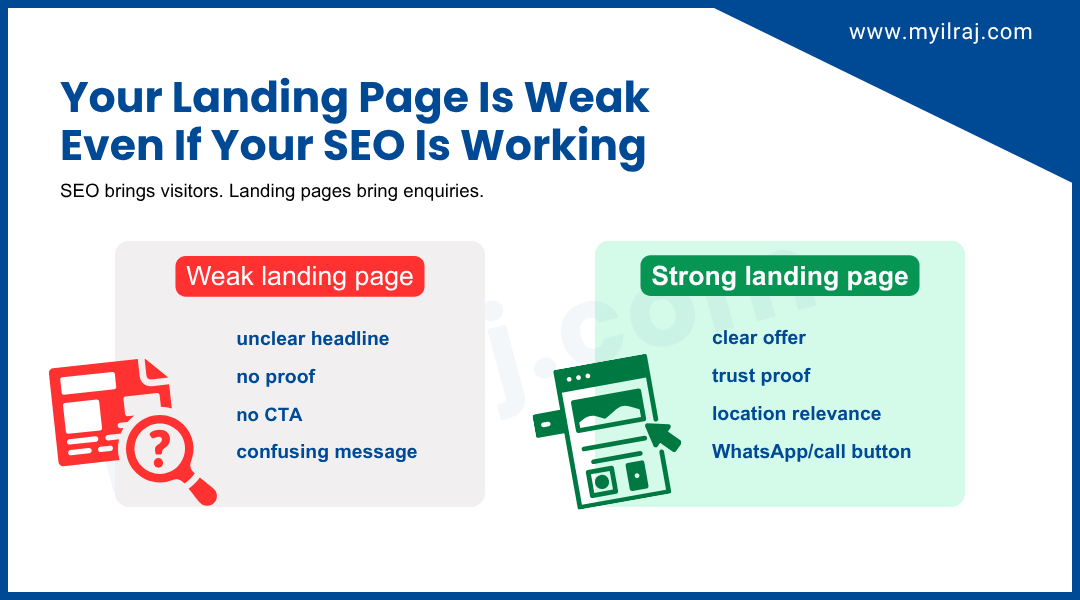
Sometimes, SEO is doing its job properly. Google brings the visitor to your website. But visitors, after landing on the page, may not feel clear, confident, or ready to contact you.
Here, the problem is not SEO, but your landing page. Many business websites have a decent design, but the headline is not clear.
The opening paragraph does not explain the offer properly.
Sometimes, the content talks about the company and not the customer’s problem.
When you read through the content, you may not have a strong benefit-driven message, no proof, no service clarity, and no simple lead capture path.
So today, check your website like a first-time visitor. Ask these questions below;
- Does it quickly explain what you offer?
- Does it show your location relevance?
- Does it make the visitor trust you?
- Does it guide them toward a call, WhatsApp message, or a Booking form?
Remember, a weak landing page can silently waste good Google traffic. That’s why your business website is not getting inquiries.
4.1. Your Page Should Answer These Questions Quickly
When someone lands on your website from Google, they should not struggle to understand your business.
Within 3 to 5 seconds, your page should answer the following five questions:
- What do you offer?
- Who do you help?
- Why should someone trust you?
- What result can they expect?
- What should they do next?
As far as I have seen, this is where many landing pages fail. They look nice, but they do not communicate clearly.
A business owner, startup founder, or local customer does not have time to decode your website. They want quick clarity.
Your webpage should speak directly to their problem, show your service value, build trust with proof, and guide them to take the next action.
Key Takeaway:
SEO can bring visitors. But your landing pages must convert those visitors into enquiries..
5. There Is No Clear CTA on Your Website
I have seen many business websites having good content, service details, and even decent organic traffic.
But still, they may not get enquiries, and one major reason is that they don’t have a clear action path.
A visitor from search may read your page, understand your service, and feel interested. But if you do not guide them properly, they may simply leave.
This is one of the quiet reasons why a business is not getting leads from Google.
HubSpot’s research found that personalised and well-placed CTAs convert 20% better than generic ones. (Source: HubSpot)
Do not make your visitors think too much about what to do next. If they want to talk, they should easily find your mobile number or consultation booking form.
Again, the CTA should not only appear at the bottom. It should appear naturally after every important section.
Especially place a CTA after you explain a problem, solution, benefit, or service process.
For example, after explaining an SEO issue,
You can guide them with simple CTAs like “Book an SEO consultation,” “Request a website SEO audit,” “Talk to an SEO consultant,” or “Improve your Google visibility.”
6. Low Trust Signals Can Stop Visitors from Contacting You
A visitor may like your service, read your whole page, and still hesitate to contact you. Because interest alone does not create enquiries. It needs Trust.
I audit at least 2 business websites every week (view case-studies) and witness this pattern. The website performs best in explaining the service, but there are no testimonials, no case studies, etc.
They may have no author identity, no portfolio, no reviews, no business address, and no proof of results.
For them, they may feel everything is clear. But from the visitor’s side, one doubt remains: Can I trust this person or company?
If your website does not show a clear experience, people may hesitate.
If there is no face, no story, no client proof, no business location, the visitor may go back to Google to check another provider.
This is also why your competitor may be getting more enquiries than you, even with a similar service. I have explained the full comparison in my guide on why competitors rank higher on Google.
I hope you know about EEAT, which is becoming more important these days. Your website should show experience, expertise, authority, and trust in a natural way.
Check your website today to see whether it gives enough proof for the visitor to feel safe before contacting you.
According to BrightLocal’s Local Customer Review Survey, 98% of people read online reviews before making a decision. Thus, every business should pay attention to trust signals and not just rankings. (Source: BrightLocal)
6.1. Trust Converts Traffic Into Leads
People do not contact a business just because they rank on Google. They may contact only when they feel the business understands their problem and can solve it properly.
Trust-building elements are not decoration; they are a part of lead generation.
A good testimonial, a real project example, a clear author bio, a proper business address, helpful content, and visible experience are a few examples.
These elements can make a visitor feel confident.
Many times, the SEO leads problem is not traffic; it is a hesitation. The visitor is interested, but the website does not remove their doubt.
Before investing in more SEO or a website redesign, diagnose what is actually stopping the enquiries.
Read my complete guide on how to diagnose your website problems before spending money to help identify the issue in SEO, messaging, trust, or something else.
Key Takeaway:
When trust improves, website visitors are more likely to take the next step.
7. Poor Local SEO Can Reduce Lead Quality
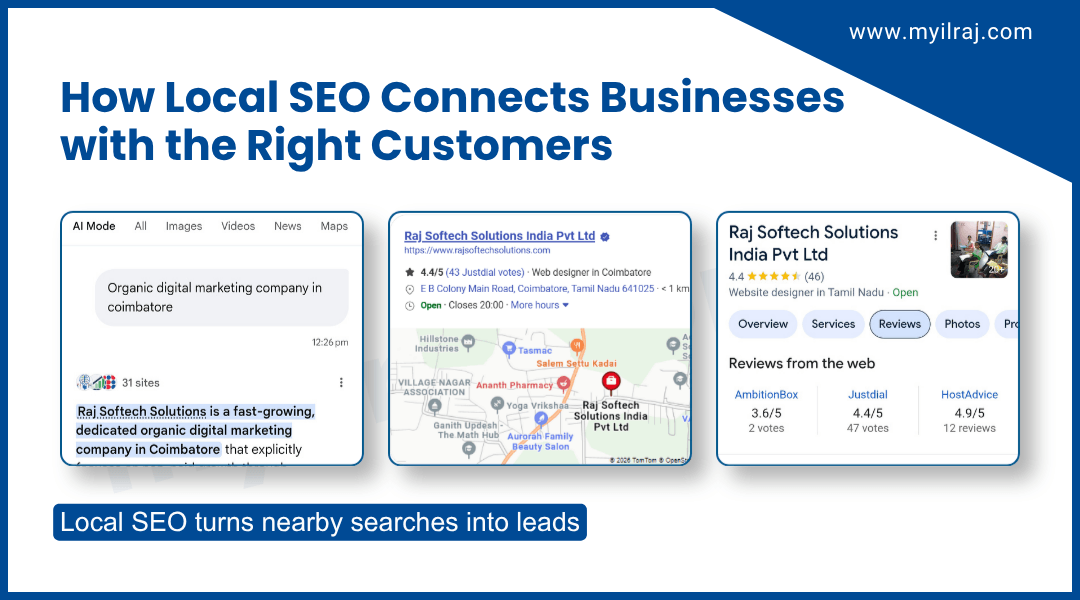
Another issue why businesses are not getting leads from Google is poor local visibility.
Many business owners focus only on website ranking, but they forget Google Maps, Google Business Profile, and Near Me Searches.
Local SEO lead generation becomes very important these days.
A Coimbatore business may rank for broad keywords. But if it does not appear properly on Google Maps for local searches, it will lose high-intent nearby customers.
For example, imagine someone searching from Gandhipuram, Peelamedu, RS Puram, Saravanampatti, or Saibaba Colony. They prefer a business that looks active, nearby, trusted, and easy to contact.
Check your Google Business Profile today and observe the reviews, NAP details, and service area.
Optimize them and improve local trust signals like photos, customer reviews, local content, and actual business information.
Every business today needs better visibility from nearby customers. You should not ignore Local SEO services in Coimbatore.
Local SEO connects your website, Google Maps presence, reviews, and service-area relevance altogether. This will improve your lead generation.
8. Your Content Attracts Readers, Not Buyers
Writing blogs is important for SEO, but not every blog post will generate quality leads directly.
- Some blog posts may bring awareness.
- Some blog posts may build trust.
- Some blog posts may help people compare options.
- Some pages are meant to convert visitors into enquiries.
If your business is not getting leads from Google, check what type of content is bringing traffic.
For example, when your website ranks mostly for basic educational blogs, create new content that connects readers to decision-making pages.
I will not say writing educational content is useless; it may indirectly build trust.
This is why I always look at content like a funnel, not just as individual blog posts.
8.1. Awareness Content
Awareness content helps people understand the problem.
For example, a blog post like “Why Businesses Struggle to Rank on Google” educates my readers and builds trust.
It may not generate leads, but it helps people realize why their website is not performing well.
8.2. Consideration Content
This type of blog post helps readers compare options and make better decisions.
A topic like SEO Consultant vs SEO Agency is useful in helping readers gain clarity before taking an action.
Why, because they are already thinking about hiring SEO support and want clarity now.
8.3. Conversion Content
Conversion content is where visitors are closer to enquiring. Check my website pages like SEO Consultant in Coimbatore or a Local SEO service page.
These pages should clearly explain the service, build trust, and guide the visitor to book a consultation, call, or send an enquiry.
Key Takeaway:
A good content strategy should also connect educational blogs to useful next-step pages.
Let me show an example of this kind of content. If someone is unsure whether their SEO is working or not, guide them to How to Check If SEO is Done.
9. Your Website Experience May Be Pushing Visitors Away
Sometimes, the website visitors may not convert because the website experience is poor. Even if the visitor is interested in contacting you, the website makes it difficult for them to continue.
The contact page may load very slowly, the mobile layout is not comfortable, or the form fields are confusing.
Sometimes, the enquiry form asks too many questions.
- There is no clear WhatsApp or call option.
- Sometimes, the contact page is filled with banners, popups, sliders, etc.
From the business owner’s side, the website may look complete. But from the visitor’s side, it may feel tiring.
Nowadays, people search mostly from their mobile phones.
If they cannot read your content properly, find your contact details, or take action easily, they will choose another business.
A good website experience does not mean a fancy design. It means speed, clarity, easy navigation, visible contact options, and a smooth path from interest to enquiry.
10. How to Fix the SEO Leads Problem?
One last thing, if your business is not getting leads from Google, don’t look at rankings alone.
Pay attention to keywords, pages, trust, local visibility, CTA, and follow-up path.
SEO lead generation improves when all these parts work together.
10.1. Target Buyer-Intent Keywords
Focus on decision-making intent keywords and not information-seeking intent keywords only.
A few example keywords from my website are;
- Hire an SEO consultant,
- Local SEO services near me,
- SEO consultant for small business,
- SEO services for a business website.
These keywords bring people who are closer to taking action.
10.2. Create Strong Service Pages
Every primary service of your business should have a separate, clear, and useful page.
A good service page should explain the problem, benefits, process, and expected outcome.
Add FAQ, trust signals like past project results, testimonials, etc., and a proper CTA.
If your service page is weak, even good SEO traffic may not convert into enquiries.
10.3. Improve Local SEO Visibility
Google Maps visibility is important for every business with a local presence.
Optimize your Google Business Profile, collect reviews regularly, create city-based pages, and publish local content.
Strong Local SEO helps attract nearby customers with better buying intent.
10.4. Add Clear CTAs Across the Website
Don’t add CTAs only at the bottom of the webpage, and don’t wait for visitors to scroll to the bottom to take action. Add a clear CTA after every important section.
Guide them to call, WhatsApp, fill an enquiry form, request an audit, or book a consultation when they are ready.
10.5. Build Trust Before Asking for Leads
People contact you only when they have trust in you and your services. Hence, give them enough confidence.
Add testimonials, case studies, real photos, personal experience, reviews, portfolios, and proof of results.
Trust reduces hesitation and improves conversions.
10.6. Connect Blogs to Service Pages
Your blog posts should not stand alone. Use internal links to move readers from awareness content to decision pages.
For example, a blog about why your businesses in Coimbatore need an SEO consultant should naturally guide readers to your SEO consultant page.
What I Usually Check During an SEO Lead Audit
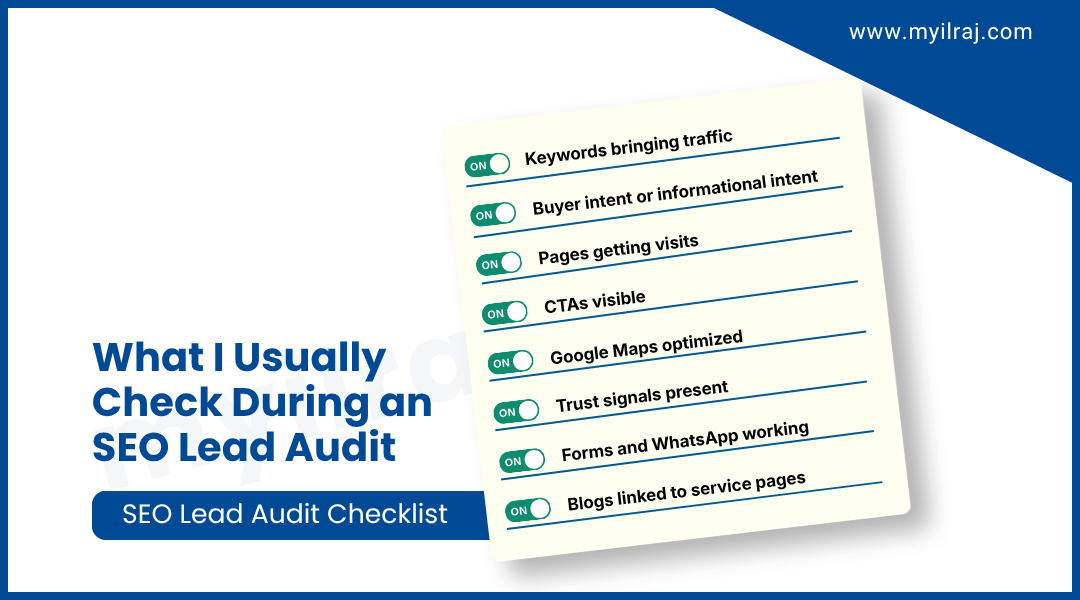
Whenever I check why a business is not getting leads from Google, I don’t look at rankings alone. Rankings are useful, but they do not tell the whole story.
I will look at the whole journey from search query to enquiry.
My Step 01:
Which keywords are bringing traffic?
Are those keywords buyer-intent search or only informational search?
Then, I will check the pages that get visits (like blogs and service pages).
My Step 02:
Now, I observe the conversion path. Are CTAs visible?
I will check if visitors can easily call, WhatsApp, fill an enquiry form, or book a consultation.
My Step 03:
If the business has a local presence, I also check Google Maps visibility.
Is the Google Business Profile optimized?
I will check their reviews, photos, proper service areas, and NAP details for proper presence.
Finally, I check their trust signals and internal linking.
Most of the time, the SEO leads problem is not a single issue. It is a combination of keyword intent, page quality, trust, local visibility, and poor conversion flow.
What Should You Do If Your Website Is Not Generating Leads?
Your website is already receiving visitors, but enquiries are still low.
Getting more website traffic is not always the answer.
The first step is to identify the real problem instead of making random SEO changes.
To fulfill this, start by asking these questions:
- Is your website attracting the right audience?
- Does your homepage clearly explain what you offer?
- Are your services easy to understand?
- Is there a clear call to action on every important page?
- Does your website build trust through testimonials, case studies, and business information?
- Is your website technically healthy and easy for Google to understand?
- Are visitors able to contact you without confusion?
Many Coimbatore-based businesses spend more on SEO, Google Ads, or social media. But they never understand why their website isn’t converting.
A professional SEO Website Audit helps identify the actual issues affecting your rankings, user experience, Local SEO, AI visibility, and enquiry generation.
Instead of guessing, you will receive a clear action plan that prioritises the improvements likely to have the biggest business impact.
Conclusion
Ranking on Google is not the final goal after AI changes the way people search.
The real goal is to attract the right people, build trust, and convert visitors into business enquiries.
If your business is not getting leads from Google, don’t look at rankings only.
Observe keyword intent, landing pages, Local SEO, trust signals, and conversion paths.
Sometimes, your SEO may bring people, but your website may not give that trust and confidence to take action.
That’s why my SEO process will not stop with clicks and traffic. I will connect search visibility with your business growth.
If you want to understand why your website is not generating enquiries, explore my SEO consulting services or book a consultation.
A proper SEO audit can help you identify where visitors are dropping off and what needs to be fixed first.
FAQ: Why Your Business is Not Getting Leads
Your business is not getting leads from Google because you are targeting the wrong keywords, attracting low-intent traffic, using weak landing pages, or missing clear CTAs and trust signals.
Website traffic may not convert when visitors do not find clear service information, strong proof, local relevance, or an easy way to contact your business.
Yes, SEO can generate leads for small businesses when it targets buyer-intent keywords, supports Local SEO, builds trust, and connects content to service pages.
SEO may not generate leads if your website ranks for informational keywords. You should rank your website for commercial or local search terms that attract ready-to-act customers.
Local SEO helps your business appear for nearby searches on Google Search and Google Maps, improving visibility among people who are more likely to contact you.