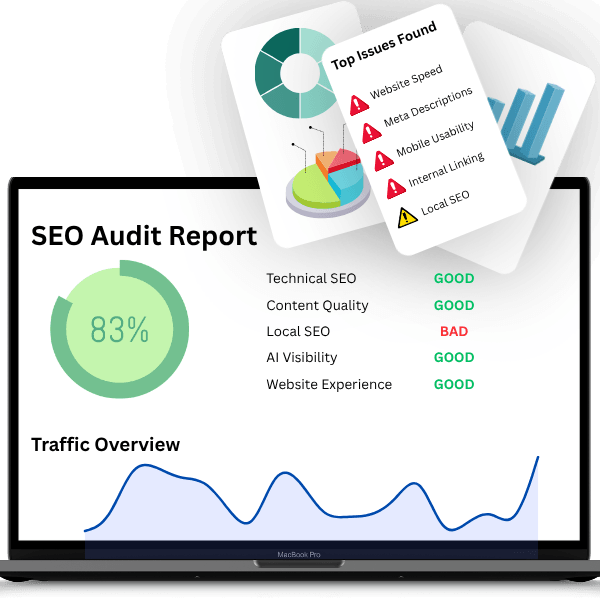

Competitors rank higher on Google not because of luck or one magic keyword. The only reason is that their website gives Google more confidence. And that confidence comes from stronger topical authority, better internal links, clearer content, and more visible trust signals. Understanding this gap is the first step to closing it.
Imagine yourself as a business owner who searches for your main business keyword on Google. If you see your competitor ranking above you, how will you feel?
I have seen this many times. The first thought is, “Why do competitors rank higher on Google?”
My service is good, and my website is also there, so why is Google showing them above me?
One thing you must understand is that Google is not emotionally choosing your competitor. Google just compares signals.
Your competitor may not be ranking higher because of a single magic keyword or a single backlink.
But they have gained Google’s confidence in their website.
Some reasons may be that their content is clearer or their internal links are stronger.
Maybe they have better trust signals, a good local SEO presence, or a stronger Google Business Profile activity.
That is why I am saying ranking gaps should not be seen only as a keyword problem. It is a confidence problem across Google and AI systems.
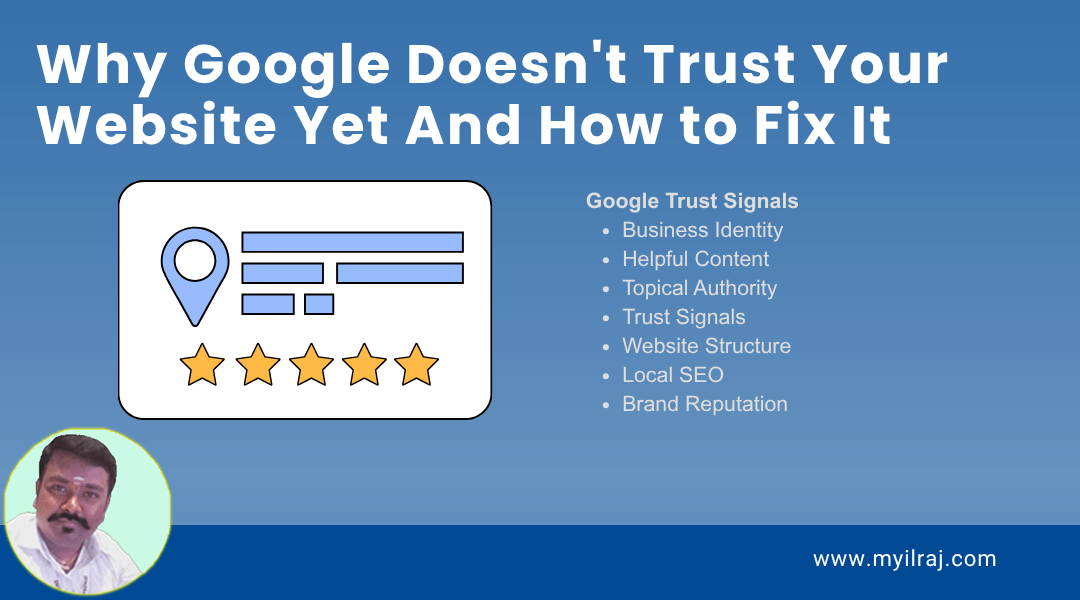
In my previous article, I explained why Google doesn’t trust your website yet. This article continues from there and here, I am explaining why your competitor may be giving Google more reasons to rank them higher.
1. Google Is Comparing Confidence, Not Just Keywords
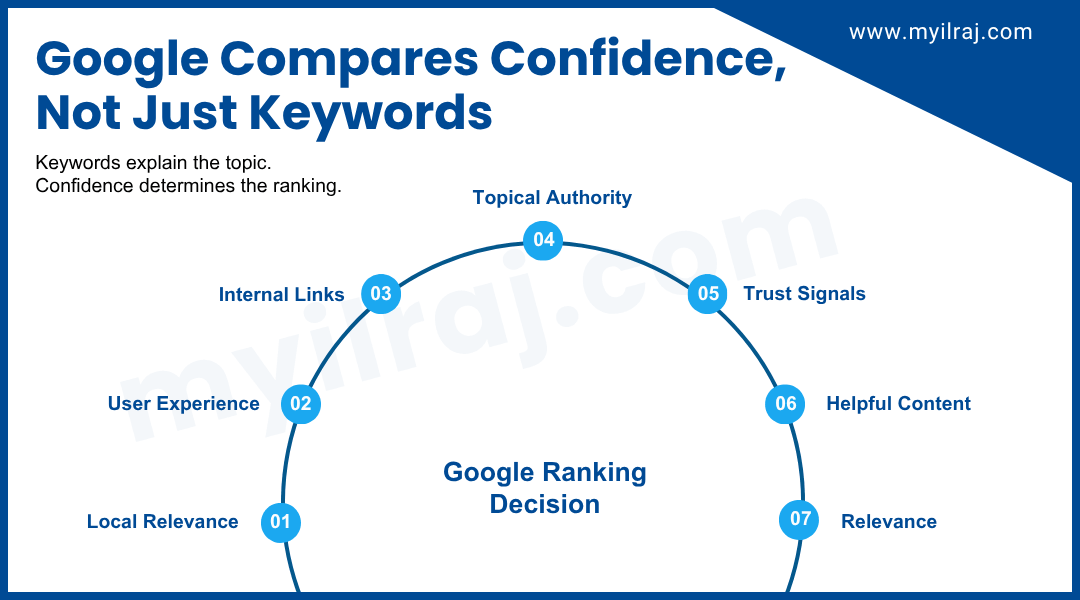
Many business owners think that ranking on Google is all about adding the right keywords on a page.
But Google does not rank a website based on the keywords. However, keywords help Google understand the topic.
But in 2026, ranking usually depends on which page gives more confidence to the user.
For example, your website and your competitor’s website may both mention the same digital marketing service.
But your competitor’s page may explain the service more clearly, answer the customer’s questions better, and show stronger trust signals.
Their website also has better internal links and provides a smoother user experience.
Today, Google and AI systems compare relevance, helpfulness, trust, clarity, authority, and local relevance.
If a competitor’s page gives better answers and fewer doubts, Google may feel more confident showing that page above yours.
So, next time, when you ask, “Why do competitors rank higher on Google?” don’t look only at keywords. Just observe the full page experience.
Key Takeaway:
Your competitor may rank higher because Google finds more reasons to trust, understand, and recommend their page.
2. Your Competitor Has Better Topical Authority
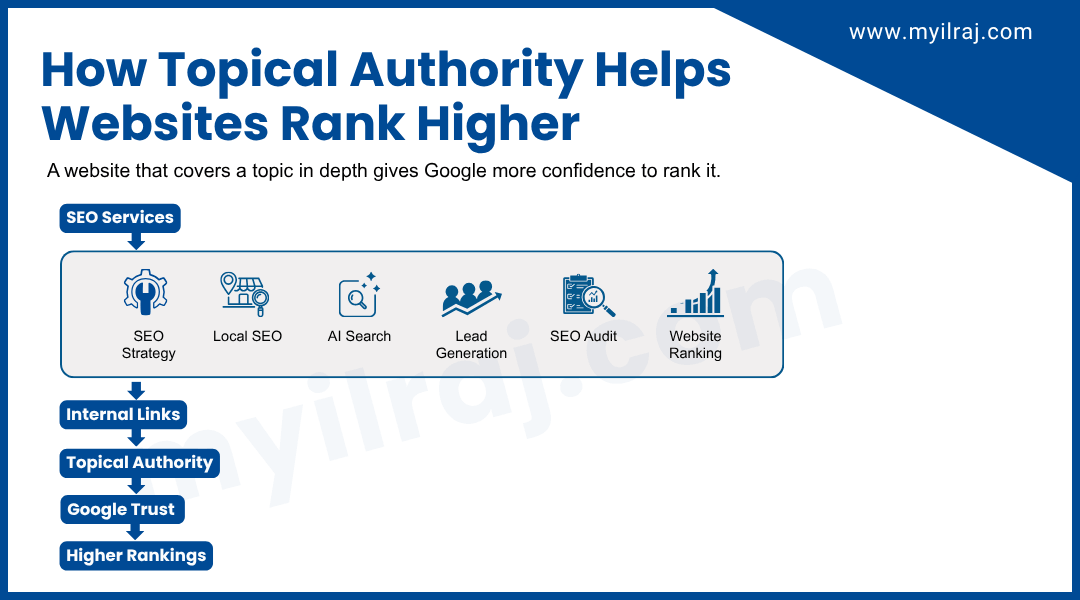
Topical authority is a big reason why your competitor may rank higher than you.
A service page is usually not enough to prove your expertise. Your competitors may have stronger service pages, more supporting blogs, and content that answers more customer questions.
For example, if two businesses offer SEO services, Google may compare how deeply each website explains the subject.
One website may only have an “SEO service” page.
But another website may explain SEO strategy, Local SEO, website audits, and Google Maps visibility. They also discuss lead generation, AI search, and business discoverability.
Now, tell me which one looks more useful?
This is why I always say ranking gaps are not only keyword gaps. There are often authority gaps in your niche.
I have explained this earlier in my guide on why businesses struggle to rank on Google.
2.1. One Page Cannot Build Complete Authority
One service page cannot answer every customer’s question.
Because a customer may want to know:
- What exactly do you offer?
- How does your service work?
- How much time does it take?
- What problems do you usually solve?
- Why should they trust your approach?
Let me give you an example.
An SEO consultant’s page can explain the SEO service. But it cannot fully explain Local SEO, technical SEO, AI Search, and website audits.
That is why supporting blogs is needed. Every blog gives Google, AI systems, and users more reasons to understand your expertise.
2.2. Related Blogs Support Main Service Pages
Every blog must be interconnected and should not stand alone. They should support your main service pages.
For example,
- A blog about competitor rankings must link to your SEO consultant page.
- A blog about Local SEO must support your Local SEO service page.
- A blog about website trust can support your SEO audit page.
This creates a clear connection between problems, explanations, and services.
In the last 1 year, I have reviewed nearly 150+ business websites. Most of the sites publish blogs regularly, but those blogs never guide readers to service pages.
Even though those blogs create traffic, they do not create the right business direction.
Key Takeaway:
When related blogs support main service pages, Google understands your topic depth better.
3. Your Competitor’s Internal Linking Is Stronger Than Yours
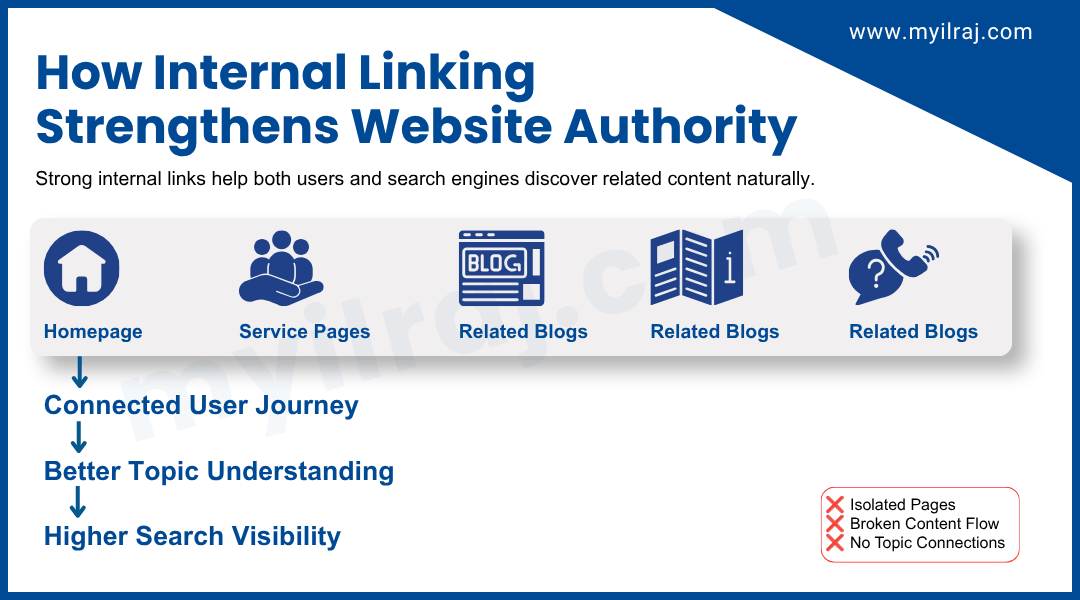
The third reason why your competitor may rank higher on Google is stronger internal links.
As said above, after reviewing 150+ business websites, I revealed that the internal linking is not structured.
Their websites have good pages, but those pages are not connected properly.
- The homepage does not clearly link to important services.
- Services pages do not link to helpful blogs.
- Blogs do not guide readers back to the service pages.
- Related guides sit separately without any connection.
The website may look complete from the design point of view, but from Google’s side, the structure may look weak.
Your competitor may be doing this better. Their homepage may link to their service pages.
Their service pages may guide users to related blogs. Their blogs may bring readers back to enquiry pages.
At last, their related guides may connect one topic with another.
This type of link helps Google and AI systems understand which pages are important and how each topic is connected.
Key Takeaway:
Internal links are not just for SEO bots. They should guide real visitors.
A person reading about a problem should be naturally guided to the right solution page.
4. Your Competitor Website Builds More Trust
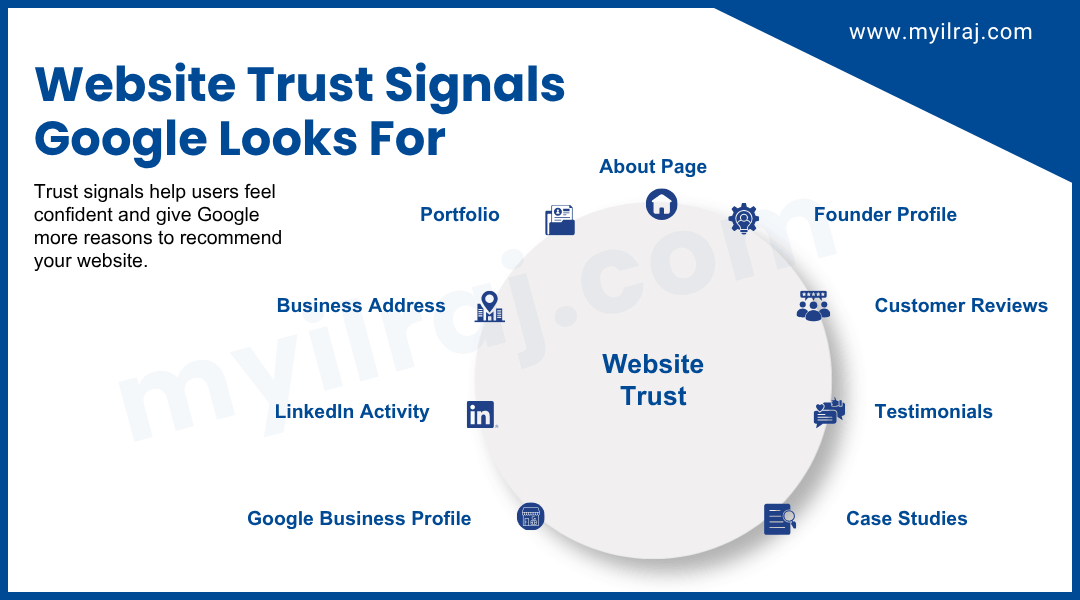
Sometimes, your competitor ranks higher than you because their website builds more trust than yours.
This is another important reason that I found after reviewing 150+ business websites.
Two businesses may offer almost the same service. But one website shows testimonials, reviews, real photos, case studies, and proof of results.
They also have a clear founder profile, business address, portfolio, and active social profiles.
The other website simply says, “We provide the best service.”
Now, answer me: Which one will feel safer for a customer?
I mostly say yes to the first one.
Google and AI systems also look for signals that help users find reliable and helpful information.
Therefore, if your competitor’s website looks more transparent, active, and credible, Google may find it more confident there.
Here are the important website trust signals that matter in 2026:
- A strong About page,
- Visible author or founder identity,
- Real customer reviews,
- Clear business address,
- Case studies & testimonials,
- LinkedIn Activity,
- Local service,
- Active GBP profile.
These are not just design elements. They are website trust signals.
That is why I always tell business owners not to hide behind generic service pages.
Show who you are, what you have done, and explain why people can trust you. I explained this deeper in another blog post on website trust signals.
Key Takeaway:
If your competitor’s website looks more credible and transparent, Google will find more reasons to show it above yours.
5. Your Competitor’s Local SEO Signals Are Stronger
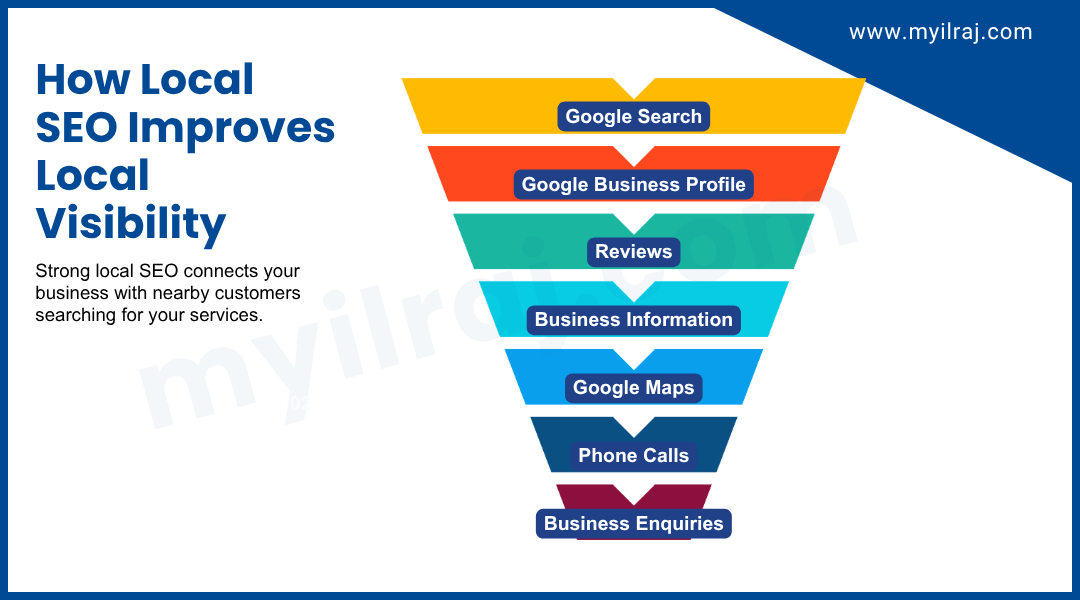
Your competitor may rank higher because their local SEO signals are stronger. If your business depends on local customers, you need to rethink your strategy.
In cities like Coimbatore, websites may have a weaker website, but stronger Google Maps visibility.
They may have more reviews, better local photos, complete business details, consistent NAP details, and an active GBP profile.
People may look at the business as more active and trustworthy.
From Google’s point of view, the business may look more relevant for local searches.
For example, if two businesses offer the same SEO services in Coimbatore, Google may compare their local presence.
One business may have updated photos, service areas, reviews, location pages, and local content.
Another business may only have a basic website with no strong local signals.
In those cases, the competitor can get more visibility, especially for location-based searches.
This is why Local SEO services in Coimbatore are important. Local SEO helps connect your website, GBP profile, service areas, and Google Maps visibility together.
According to BrightLocal’s Local Consumer Review Survey, 98% of people read online reviews before contacting a local business.
This means your competitor’s review count and GBP activity directly influence whether a customer calls them or you.
Key Takeaway:
For local businesses, Google Maps visibility often matters more than website design. Stronger local signals win more nearby customers.
6. Your Competitor Page Matches Search Intent Better
Sometimes, your competitor ranks higher because their page answers the search better than yours. This is one of the most common things I notice during competitor SEO analysis.
A business may target the correct keyword, but the page may not satisfy what the searcher really wants.
For example, if someone searches “SEO consultant vs SEO agency,” they are not looking for a normal SEO service page.
They want to compare, read pros and cons, cost difference, decision help, and practical advice.
In this case, when your page only sells your service, but your competitor explains the topic clearly, Google may prefer their page.
The same happens on many business websites.
- A user wants a price, but the page hides the cost.
- A user wants local proof, but the page sounds generic.
- A user wants your process, but the page is vague.
- A user wants trust, but there is no proof.
This is why SEO consultant vs SEO agency type content works well. Because it helps the reader decide, not just read.
Key Takeaway:
When your page matches intent better, your chance of ranking improves.
7. Your Competitor Website Experience Is Better
Your competitor’s website may rank higher because their website is easier to use than yours.
I am not talking about fancy website design here. I am talking about a simple website experience.
- Their website may load faster.
- Their mobile layout may be cleaner.
- Their website navigation may be easier to understand.
- Their service pages may be easier to read.
- Their WhatsApp button, call button, or enquiry form may be clearly visible.
Even though your website content is good, the page experience is weak.
The visitor has to search for contact details, the menu is confusing, and the page has too many sections.
Sometimes, the CTA is not clear and is placed at the bottom of the page. On mobile, the layout feels confusing.
When this happens, users leave faster.
Even though your competitor may not have a perfect website, they may rank higher.
Because their page is easier to read, navigate, and act on. In such cases, users may engage better.
Google, AI systems, and users prefer pages that give clarity. A good website experience reduces confusion and helps visitors take the next step.
So, next time, when asking why competitors rank higher on Google, check the user journey.
Sometimes, the ranking gap starts with a poor website experience.
Key Takeaway:
A page that is easy to read, navigate, and act on will always outperform a page that looks impressive but confuses visitors.
8. Your Competitor’s Business Message Is Clearer Than Yours
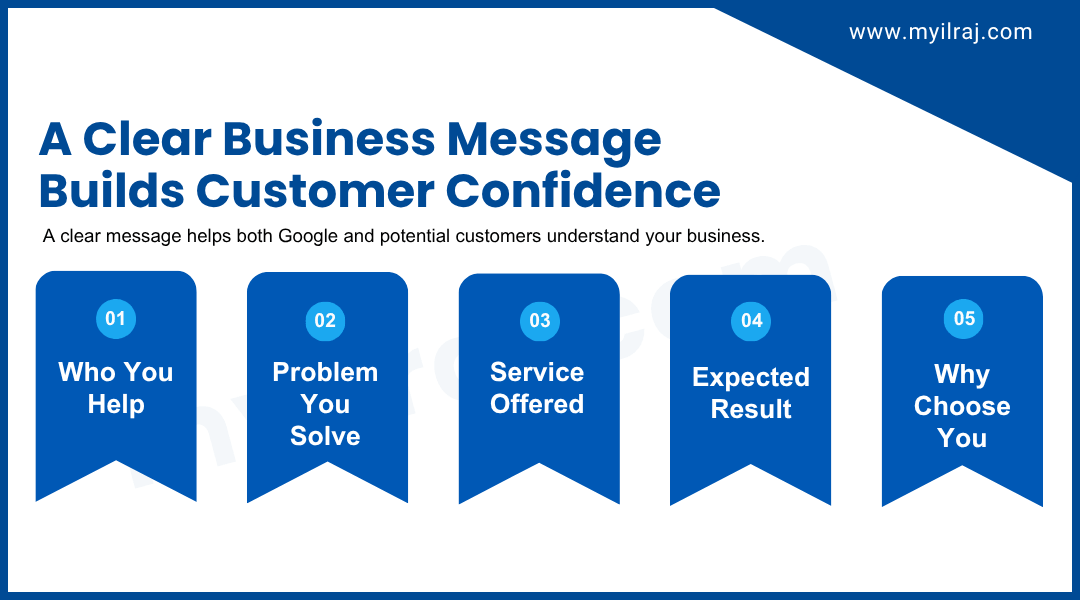
Your competitor may rank higher simply because their business message is clearer than yours.
After reviewing 150+ business websites, I often notice this issue. Many businesses try to say everything on the homepage.
They offer SEO, social media, ads, website design, branding, lead generation, automation, etc.
But after reading the page, the visitor still feels confused.
- Who do you help?
- What problem do you solve?
- What result can the customer expect?
- Why should they choose you?
If the answers are not clear, the website becomes weaker.
Let me give you an example,
A competitor saying, “We help Coimbatore businesses get more leads from Google Search, AI Overviews, and Maps”. This is much clearer than a company saying, “We provide digital marketing solutions.”
The first message tells the audience the problem, platform, and outcome.
The second message sounds broad and generic.
Google and AI systems also need this clarity.
If your service focus, headline, audience, outcome, and positioning are weak, Google may understand your competitor better than you.
When you ask yourself why competitors rank higher on Google, check your message first. Sometimes, the ranking gap starts with unclear communication.
Key Takeaway:
If Google cannot understand who you help and what problem you solve, it will prefer the competitor whose message is clearer.
9. Your Competitor Is More Consistent in Their SEO Activity
When your competitors are more consistent in their SEO, they rank higher. I am not saying that they publish one blog every week. That is not the point here.
Here’s what the consistency means:
- Updating the service pages regularly.
- Refresh the blogs with new examples.
- Keeping their GBP profile active with posts and reviews.
- Having an active LinkedIn profile showing regular business activity.
- Important pages may be internally linked better.
One local business website updates the website once and then waits.
Another local business website keeps adding useful content, collecting reviews, and strengthening local signals.
After a few months, Google starts seeing more activity, more clarity, and more trust from the second business.
This is how competitive advantage builds through consistent activity.
Google’s trust does not usually come from one big action. It comes from repeated useful signals.
Finally, when you ask why competitors rank higher on Google, check consistency as well.
Maybe they are not doing everything perfectly, but they keep improving more regularly than you.
Key Takeaway:
Google’s trust does not come from one big action. It comes from repeated, useful signals over time.
10. How to Understand Why a Competitor Ranks Higher
Whenever a business owner asks me why a competitor ranks higher, I don’t give a quick answer.
Because ranking differences usually do not come from one keyword or one backlink. It is a combination of signals.
So, first, I compare both websites once, like a customer, and once like an SEO consultant.
While auditing the websites, I usually check:
- What keywords are they ranking for?
- Which page is ranking?
- What content depth does that page have?
- How many blogs support that page?
- Are the internal links stronger?
- Do they have trust signals?
- Is their GBP profile stronger?
- Are their reviews better?
- Are their webpages easier to use?
- Is their business message clearer?
- Are they more active online?
This kind of comparison gives a clearer picture.
For example, your competitor may not have a beautiful website. But their ranked pages may answer the user better.
Those pages show stronger proof, connect to related blogs, and have better local trust.
That is why I do every competitor analysis with clarity.
Key Takeaway:
When we understand what Google is comparing, we can improve the right things first.
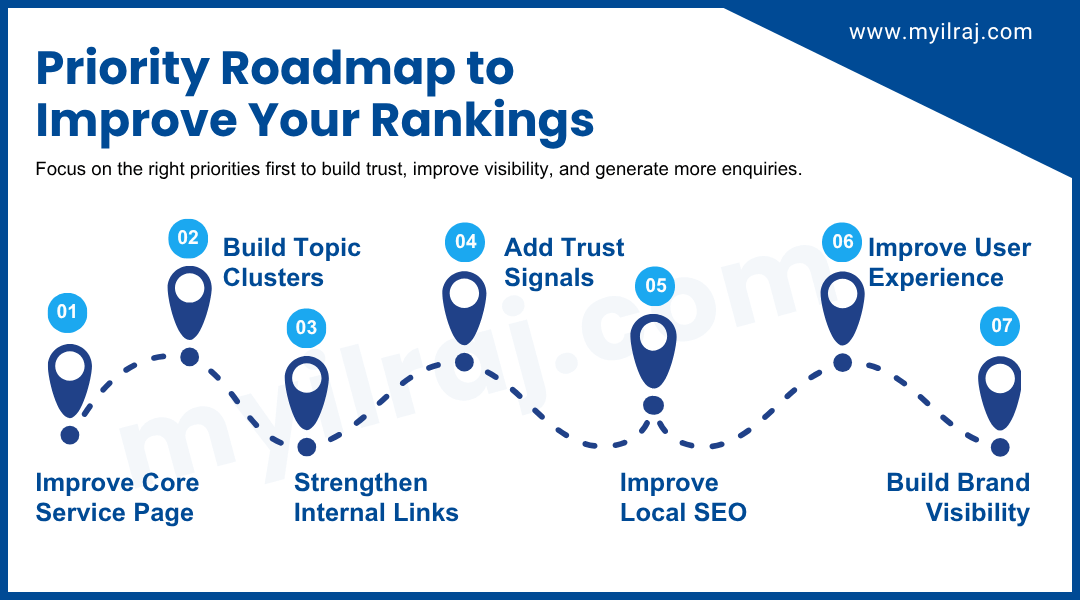
11. What You Should Improve First
If your competitor ranks higher, don’t rush to fix everything randomly. First, improve the pages, and then signals that directly affect visibility, trust, and enquiries.
In my experience, ranking gaps become easier to fix when we follow a clear priority order.
One more thing I want to tell you here is, before you start comparing your website with your competitor, first understand what is actually blocking your website’s growth.
Read this guide on how to diagnose website problems before spending money on SEO, which will help you do that step-by-step.
11.1. Improve Your Core Service Page
First, check your service page headline, offer, location details, service details, and process.
Scan the page for enough trust proof, FAQs, and CTA.
You can use my SEO Consultant page in Coimbatore as a reference for how a properly structured service page should look.
I have seen many websites lose ranking opportunities because the service page talks generally.
Further, the page does not answer real buyer questions.
11.2. Build Supporting Topic Clusters
Service pages are not enough. You have to create related blogs around customer problems, comparisons, and lead generation.
You can also answer pricing questions, Local SEO, trust signals, and your process.
These supporting articles help Google understand your expertise much better.
And such expertise gives users more reasons to trust your business.
11.3. Strengthen Internal Links
Now connect your homepage with service pages, related blogs, and guides properly.
A reader should navigate naturally from problem content to solution pages.
I have seen rankings improve faster when important pages sit alone and start receiving meaningful internal links.
11.4. Add Trust Signals
Check your website for testimonials, reviews, case studies, photos, author details, and proof of work.
Your competitor may be ranking better because their website looks more believable.
Trust signals help both users and Google feel more confident.
11.5. Improve Local SEO Presence
If you serve a local market, make sure you strengthen your Google Business Profile.
Improve reviews, local photos, service areas, NAP consistency, and location pages.
For Coimbatore businesses, local trust influences Google Maps visibility and customer decisions.
11.6. Fix User Experience and CTAs
Make sure that your website is easy to read, navigate, and contact.
Add WhatsApp, call buttons, enquiry forms, and consultation CTAs at the right place.
A good page should not make visitors search for the next step. Confusion kills enquiries.
11.7. Build Brand Visibility Consistently
Share useful content on LinkedIn, Medium, Reddit, and other social media platforms.
Update your GBP profile, collect genuine reviews, and build brand searches over time.
Competitors often win because they are more visible and consistent in their SEO process.
Conclusion
Your competitor may be ranking higher, not because they are lucky. They may be ranking better because Google has more confidence in their website.
Still, if you are wondering why competitors rank higher on Google, start comparing.
Compare trust, topical authority, internal links, Local SEO signals, user experience, and business clarity.
The ranking gap is not one single issue. It is a combination of small signals working better on your competitor’s website.
Their page has a better answer, local presence is stronger, and trust signals may be clearer.
So don’t look at competitor rankings with frustration. Use it as a signal. Ranking on Google is just one half of the SEO process.
Becoming discoverable across all platforms is important today. I have explained the full concept of website discoverability and how to fix it in another article.
If you want to understand why your competitor is ranking above your business, you can explore my SEO consulting services or book a website audit.
FAQ: Why Do Competitors Rank on Google?
Your competitors may rank higher because their website has stronger topical authority, better internal links, clearer content, and stronger trust signals.
Yes, you can easily outrank your competitors. Strong content, better intent match, internal linking, Local SEO, trust signals, and user experience can help improve rankings, especially in local and service-based SEO.
Your competitor’s content may be more focused, better connected, more trusted, or better aligned with user intent. More content alone does not guarantee better rankings.
Check their ranking page, content depth, internal links, trust proof, Google Business Profile, reviews, page experience, and whether their page better answers the search intent.
Start with your core service page, internal links, trust signals, Local SEO presence, and supporting content cluster. Fix clarity before chasing more traffic.