
Google doesn’t trust a website when it cannot understand who runs the business and what the website is genuinely about. AI systems check whether the content comes from real experiences. Trust is built through consistent signals, clear identity, helpful content, local presence, and external brand credibility. Without these, even a well-designed, indexed website may stay invisible in Google search and AI recommendations.
Many business owners ask me one common question: “My website is live, and I have added service pages. I am even publishing blogs, but why is my website not ranking on Google?”
I can understand that frustration, but the real truth is that Google’s trust is not built yet. Just having a website and publishing blogs is not enough.
Google and AI need more from the outside, like your experience, authority, local relevance, customer proof, or clear business credibility.
I saw websites publishing blogs with content that sounds generic. Their service pages have no proper internal links, no trust signals, and no strong topical authority.
Previously, I have written about why businesses struggle to rank on Google and why businesses are not getting leads from Google.
These articles will explain the picture more clearly.
Now, let us discuss why Google still doesn’t trust your website and what you can do to build that trust slowly and properly.
In simple words, if Google and AI don’t trust your website yet, it may not push your pages strongly in their search results and recommendations.
Google Trust Is Not Built Overnight
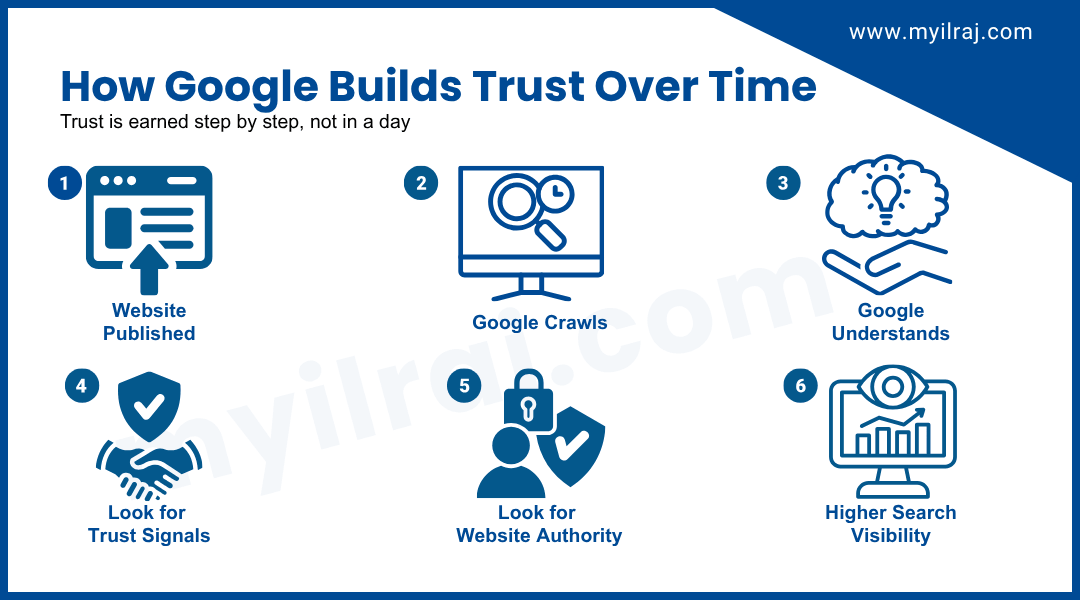
Many business owners in Coimbatore and Tamil Nadu think that once a website is live and indexed, Google should start ranking it.
To be honest, SEO does not work like that in 2026. Google needs time to crawl your website first.
When crawling, they try to understand your pages, evaluate your content, and compare your website with other websites in your niche.
Indexing in your Google Search Console means Google has found your page. It does not mean Google already trusts your website.
I have personal experience in this regard in my own website journey. Some pages started getting impressions slowly, and some pages took time.
Some topics require more supporting content before Google started understanding the overall direction clearly.
This is why consistency matters.
If Google doesn’t trust your website yet, either your website is new, or the content on your site is not strong enough.
Moreover, the same topic may not be reinforced again and again through useful blogs, internal links, and trust signals.
Key Takeaway:
Google and AI need repeated signals. One blog post, one service page, or one-time SEO work will not build website authority overnight.
Trust is built slowly through helpful content, clear business identity, topical authority, and regular improvements.
1. Your Website Does Not Clearly Show Who You Are
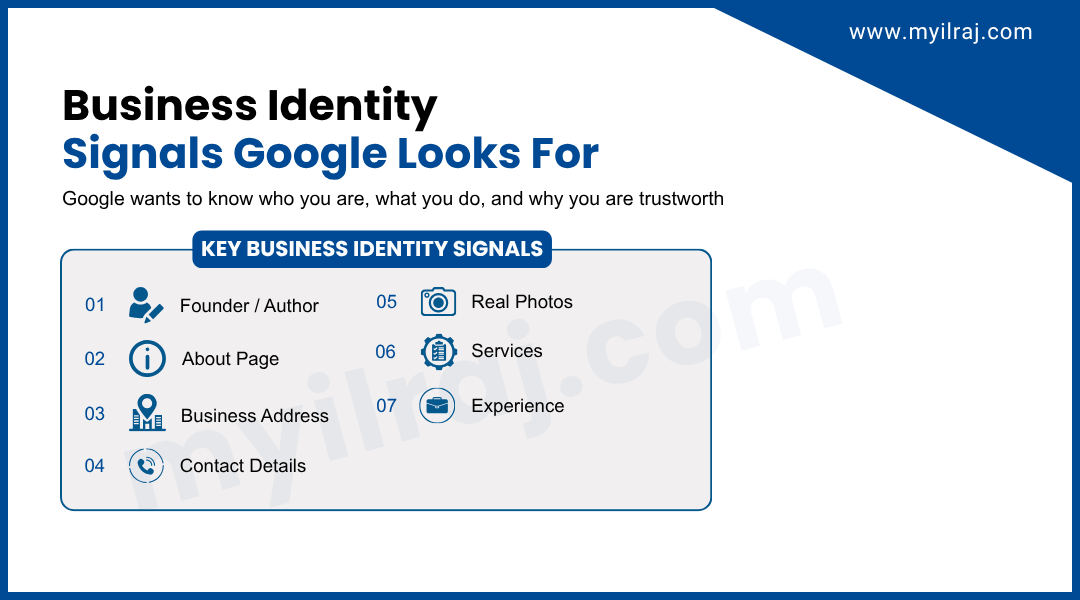
One major reason why Google doesn’t trust your website is the lack of a clear identity.
I have seen several business websites talk about services, but they don’t clearly show who is behind the business.
No proper author identity, no founder story, no clear business address, no real photos, no strong About page, and no visible experience.
When a user visits the website, this creates doubt.
Because when I visit their business website, I cannot understand who runs it or where the business is located.
Also, I cannot find their level of experience, and I ask myself why I should trust them. It happens to every visitor.
From a Google and AI point of view, this weakens website trust signals for SEO.
This is why your website should not look like a faceless service page. Make your website feel like a real business with real people, real experience, and real credibility.
1.1. Google Needs a Clear Business Identity
First thing is that Google and AI should be able to understand your business identity clearly.
- Who are you?
- What service do you offer?
- Which location do you serve?
- What is your main expertise?
For example, if a digital marketing company in Coimbatore says, “We provide online marketing solutions,” that is too broad.
But if the same website says, “We help Coimbatore businesses improve Google Search, Google Maps, and Website enquiries, the identity becomes stronger.”
This helps both users and search engines understand the business better.
A clear identity builds better trust.
1.2. Users Trust Websites That Feel Real
A website should give a feel that there is a real business behind it. It should not look just like a landing page created for collecting leads.
For example, when I review local business websites in Coimbatore, I often see stock photos, generic content, and no visible team (and owner) information.
The design may look stunning, but the trust is missing.
Real photos, location details, client examples, reviews, and practical explanations make your website feel genuine.
Key Takeaway:
When a visitor feels the business is real, they spend more time, explore more pages, and are more likely to contact you.
1.3. Author and Business Transparency Matter
If you publish blogs, guides, or service content on your business website, visitors must know who is sharing that content.
For example, on my website, when I write about SEO, I should not hide behind a generic admin name.
The reader should know that Myilraj. G is writing from real SEO experience, client work, and practical observations.
Nowadays, people trust people before they trust websites.
A clear author bio, founder profile, About page, business address, and contact details help build author credibility and business credibility together.
2. Your Content Sounds Generic
Another reason why Google doesn’t trust your website is that your content sounds like every other website in your industry.
I never say every article must be perfect. But at least don’t repeat common explanations, copied ideas, and AI-style paragraphs.
Some blogs may cover surface-level points where Google and users may not find enough reason to trust.
Many businesses publish blogs regularly, but the content does not show real experience.
There are no practical examples, no original opinion, and no client-side observations.
When you check deeply, there is no business reality and no clear point of view.
Google and AI systems do not need another generic article. In the same way, your website visitors also do not need it.
If you want to build that website authority, write blogs that are really seen, tested, and understood. This is where real trust starts.
Google’s recent E-E-A-T updates reward original, high-authority content only. Google’s Search Quality Rater Guidelines describe E-E-A-T as the core framework for evaluating content.
Why is this? Because every piece of content that we publish must show real experience, expertise, authoritativeness, and trustworthiness.
2.1. Thin Content Reduces Trust
Thin content does not mean a 300- to 600-word article. It actually means the content that does not give enough useful value to the reader.
- It gives basic definitions only.
- It repeats what many websites already say.
- It does not explain the real problem clearly.
- It does not have any practical examples from business experiences.
- It does not help the reader make a better decision.
For example, just imagine you are writing about “SEO improves website ranking.”
Here, a business owner wants to know why their website is not ranking and how to check if SEO is done or not.
If you fail to fulfill this requirement, then your content slowly weakens trust. Not only that, but the content should show real experience.
2.2. Experience-Based Content Builds Credibility
Experience-based content always feels different. Because it comes from real observation and not just theory or a cooked-up story.
Share what you noticed while auditing websites.
- Explain common mistakes you repeatedly see.
- Add examples from real business situations.
- Give your own opinion based on practical SEO work.
- Mention what usually works and what does not work.
When readers feel that you understand their real problem, they will stay longer and trust you more.
But experience alone is not enough, as the content must also be genuinely helpful.
2.3. Helpful Content Is More Than Word Count
People think long content means good content. That is not always true. A 3000-word article may still cover surface-level info.
A short section can be more powerful in solving problems.
Helpful content answers the reader’s actual problem.
- It gives clarity, not just more paragraphs.
- It guides the reader towards the next useful step.
For example, take this article on why Google does not trust your website.
Here, I explained requirements like identity, content quality, topical authority, trust signals, and practical fixes.
I never write blogs to fill space. I write to help my readers understand their problem better and take action with confidence.
Google’s Helpful Content Guidelines confirm that the pages created only for ranking will never perform better in search results. Every piece of content must genuinely help people.
3. Your Website Has No Topical Authority Yet
The third reason why Google doesn’t trust your website yet is the lack of topical authority.
Writing one or two blog posts is not enough to prove your expertise. Google and AI systems want to see that you consistently cover the subject in depth.
If your topics are scattered, Google may struggle to understand what your website is really known for.
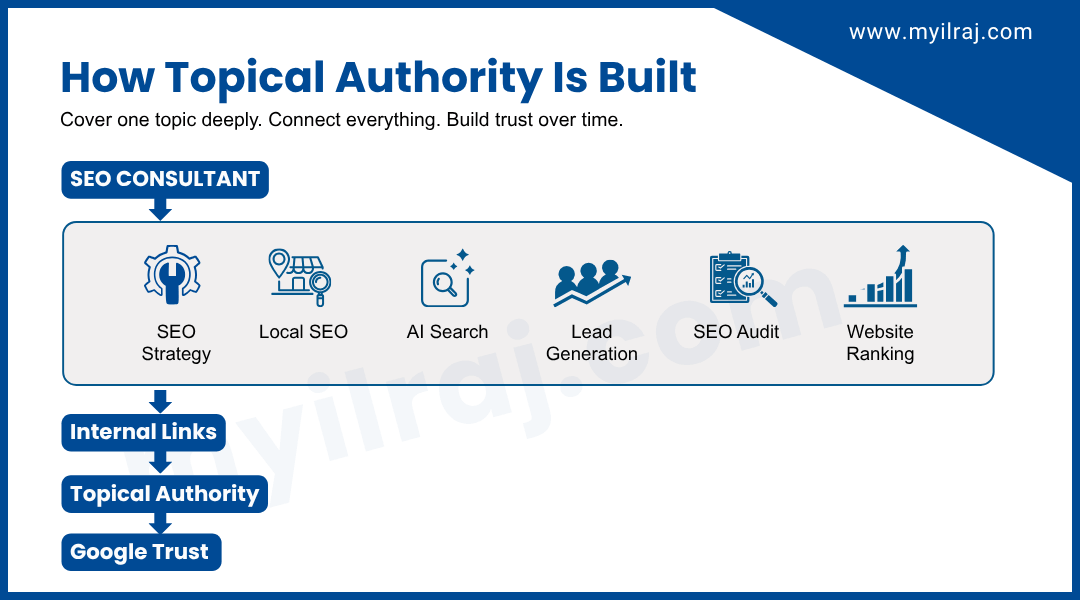
For example, my website wants to rank for the SEO consultant keyword. I should not publish random marketing topics every week.
Rather, I should talk about SEO strategy, Local SEO, business discoverability, AI overviews, and Lead generation.
This is how Google and AI systems slowly start connecting my website with a clear area of expertise.
To learn more in-depth, read my other guide on why businesses struggle to rank on Google.
3.1. Random Blogging Does Not Build Authority
Random blogging may keep your website active, and more people visit your website daily. But it will not build trust or expertise.
- One blog talks about SEO.
- Another blog talks about social media.
- Another blog talks about website design.
- Another blog talks about trending topics.
- Service pages are not connected with blogs.
The above pattern may confuse Google, AI systems, and users. If your goal is SEO authority, your blogs should support that direction repeatedly.
This is where content clusters become important.
3.2. Content Clusters Help Google Understand Your Expertise
A content cluster is a group of related pages and blogs built around one main topic.
- One main service page explains your core offer.
- Then you write supporting blogs and answer related questions.
- You also write comparison articles that help with decision-making.
- Write problem-solving blogs to build trust.
- Create FAQs to support long-tail intent.
For example, an SEO consultant’s website can write about SEO strategy, Local SEO, AI search, and lead generation.
This structure helps Google and AI systems understand that your website talks about SEO repeatedly.
It helps build depth around SEO. A content cluster becomes stronger only when pages are connected properly.
When your competitor’s content cluster is stronger than yours, they naturally rank above you. I have explained exactly what Google compares in my guide on why competitors rank higher on Google.
3.3. Internal Linking Strengthens Topic Relationships
Linking different pages and blogs on your website helps Google, AI systems, and users understand your website clearly.
- Blogs should link to related blogs.
- Blogs should link to service pages.
- Service pages should link to useful guides.
- Important pages should not remain hidden (or orphaned).
- Anchor text should clearly explain the linked page.
For example, a blog about Google trust should naturally link to blogs about ranking problems, Local SEO, and lead generation problems.
When your website structure becomes clear, your topical authority becomes stronger over time.
4. Your Trust Signals Are Weak
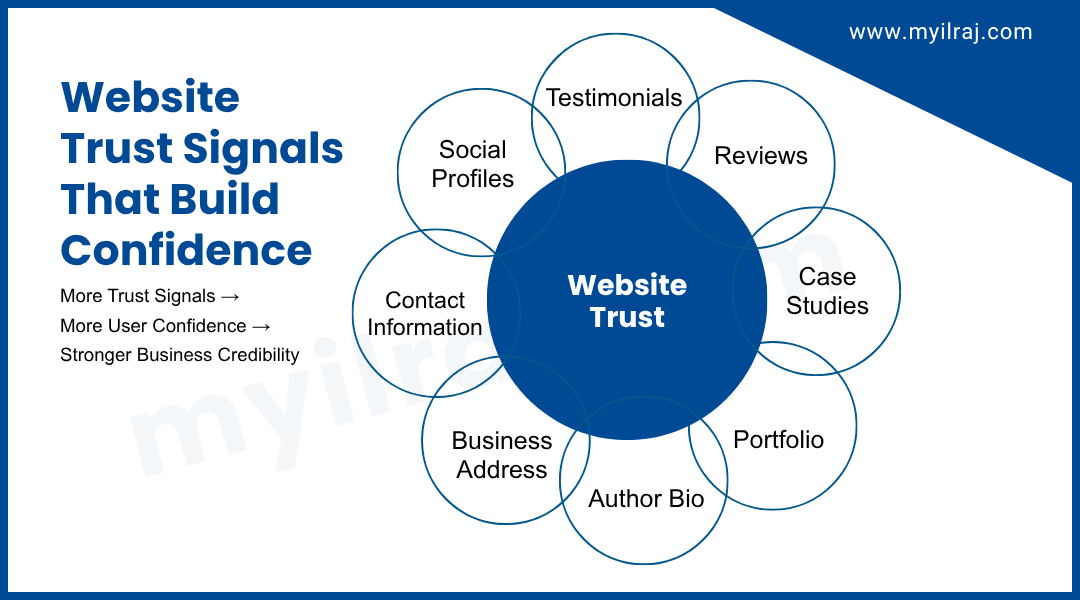
If your website has weak trust signals, users, Google, and AI systems may hesitate to trust your business.
Trust signals help to prove that your business is real, active, experienced, and reliable.
This includes testimonials, case studies, reviews, portfolio, and client examples.
A few other elements, like the author box, contact details, real business address, and social profiles, also contribute to trust signals.
I have seen many websites say, “we are experts,” but there are no reviews, no real examples, and no client results.
Not only that, they don’t mention their real business address and have no clear contact information. And this creates doubt.
Trust is not a decoration; it is a part of the SEO and conversion journey.
If people cannot verify you, they may not enquire.
Key Takeaway:
If Google and AI systems cannot see enough credibility signals, your website will never appear in search.
4.1. Testimonials Build Confidence
Testimonials help visitors understand that real people have already worked with your business.
A testimonial can show,
- What problem did the customer have?
- How your service helped them.
- What result or improvement did they notice?
- Whether your communication was clear.
- Whether they could recommend you.
For example, check our Raj Softech Solutions GBP page, and you can see our real GBP testimonials.
Testimonials reduce doubt. They help the visitor feel okay and take the next step.
4.2. Case Studies Show Real Experience
Case studies are more powerful in building your website’s trust. They show your actual thinking and working process.
A useful case study can explain:
- What problem did the business have?
- What did you check first?
- What SEO issues did you find?
- What changes were implemented?
- What improvement happened after that?
Rather than saying, I improved SEO, you can show how a local business had weak Google visibility. Then, how did you fix it step-by-step?
This gives confidence that you are not just talking about SEO. You have handled real business situations.
4.3. Reviews Strengthen Local Trust
For local businesses, reviews are the strongest trust signals because people check them before contacting.
Reviews can support:
- Local customer confidence.
- Your service credibility.
- Location-based trust.
- Your brand reputation.
For example, a Coimbatore business with updated reviews, real photos, and an active Google Business profile looks more trustworthy.
Reviews alone will not solve everything. Your reviews, testimonials, case studies, website content, and social signals must work together. It will increase your trust level and make it stronger.
5. Your Website Structure Confuses Google
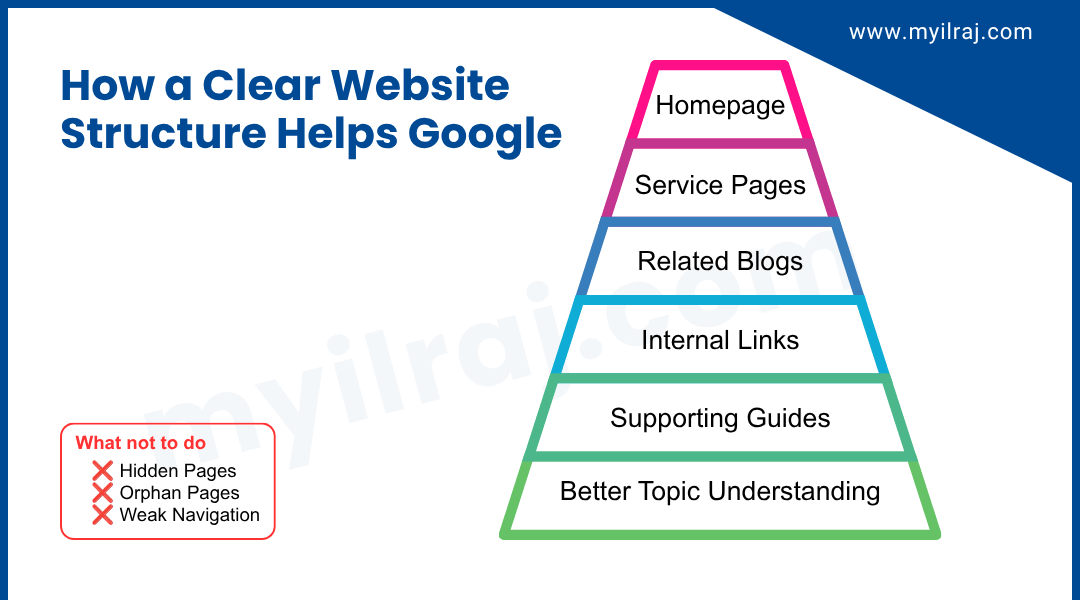
Sometimes, the problem is not only content. The website structure itself can confuse Google.
On some websites, the service pages are hidden as the navigation is unclear. Sometimes, blogs are not connected to service pages, and some pages are completely isolated (orphan pages).
If Google, AI systems, and users cannot easily reach an important page, that page may not get enough value.
- A business website must have a clear hierarchy.
- The homepage should guide visitors to the main services.
- Services pages should connect to related blogs.
- Blogs should support important business pages.
This can be achieved through internal links, which help Google understand which pages are important.
If your website has poor navigation, weak internal links, unrelated blogs, and disconnected service pages, then all is lost.
Google, AI systems, and people may struggle to understand your website’s authority properly.
5.1. Important Pages Should Not Be Hidden
Your important pages should be easy to reach from the homepage, menu, footer, or related content section.
A business website should clearly guide visitors toward the main services. If users need three or four clicks to find your service page, the structure needs improvement.
Important pages should not sit quietly. Make them visible, connected, and supported across the website.
For example, if your SEO service page is buried deep inside the website, users may not reach it easily. Even Google may take longer to understand that page’s importance.
5.2. Blogs Should Support Service Pages
Blogs should not work like separate articles floating alone on the website. They should support your main service pages.
I have seen many businesses publish blogs regularly. But none of them guide readers toward service pages.
If your blogs educate users but do not connect to your services, you may miss SEO value and lead opportunities.
For example, a blog about why Google doesn’t trust your website should naturally connect to your SEO consultant page, SEO website audit page, and Local SEO service page.
5.3. Internal Links Guide Google and Users
Internal links are like road signs inside your website. They help your site visitors know where to go next and help Google understand relationships between topics.
A good internal link should use clear anchor text and tell users what they will find next.
When internal links are planned properly, Google can understand your content better.
Visitors can explore more pages, and your topical authority becomes stronger.
For example, a blog about ranking issues can link to another blog about lead generation and then to the SEO consultant page. This creates a natural journey.
6. Your Local SEO Signals Are Not Strong Enough
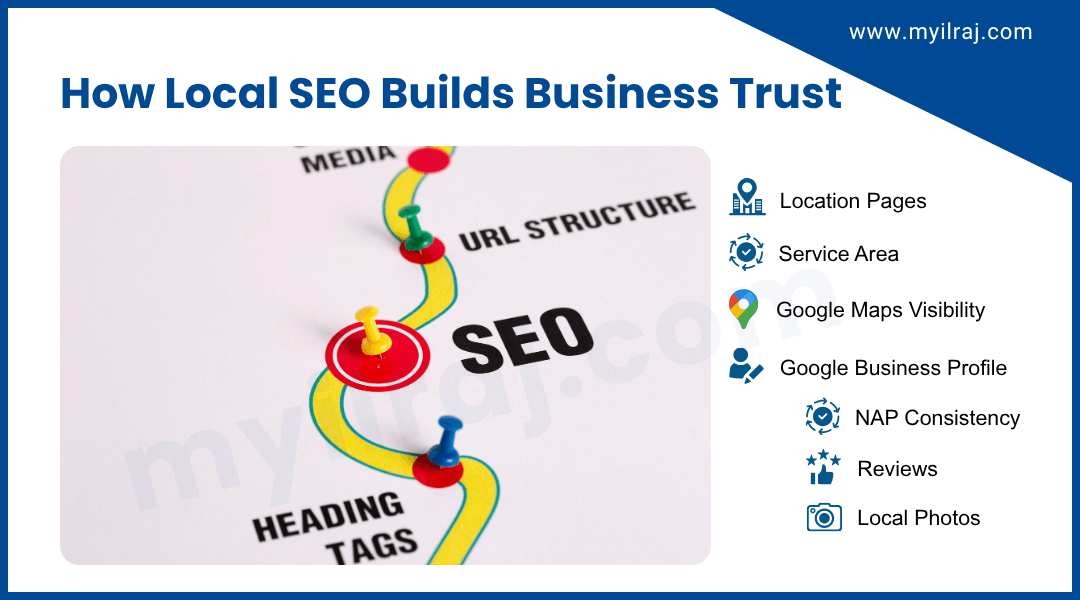
If your business depends on local customers, your website alone will not build enough trust.
Google checks for local signals to understand whether your business is active and trustworthy in a specific location.
For example, a Coimbatore-based business may have a website. But if Google cannot clearly see the service area, reviews, and customer intent, local trust will remain weak.
Many local business websites have service pages, but their Google Business Profile is incomplete.
Even if they have a profile, they have no regular photos or reviews. Name, address, and phone number details are not correct.
There are no local landing pages or service-area content. Sometimes, they don’t appear properly on Google Maps at all.
Local customers often search with strong local intent. They may search for a service near them and contact the business that looks more active and trusted.
To improve your local trust, focus on Google Business Profile, reviews, local photos, NAP consistency, and location pages.
You can also explore my Local SEO services in Coimbatore to understand how local visibility can be improved properly.
7. Your Website Has No External Reputation Signals
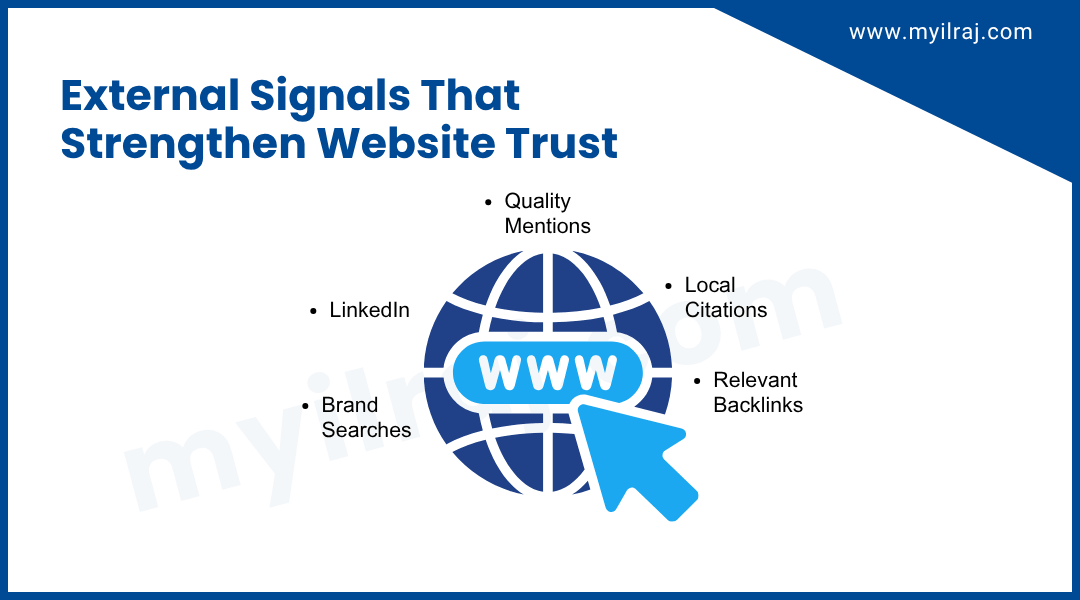
These days, Google does not look at your website alone. It also tries to understand how your business is seen outside your website.
I am not talking about backlinks or submitting your website to 100s of low-quality directories.
The quantity of backlinks has less importance than relevance and quality in building real website trust.
I am talking about quality mentions, brand searches, LinkedIn visibility, local citations, and genuine backlinks.
Some businesses have good PR mentions, social proof, and business references from relevant places.
For example, people search your brand name and visit your LinkedIn profile. They see your business profile, and that will support your website’s reputation.
If your website has no external signals, Google and AI systems may take more time to understand your credibility.
7.1. Brand Mentions Matter
Brand mentions help Google, AI systems, and users understand that your website exists everywhere.
For example, when people search my name with my service, “Myilraj SEO Consultant,” it shows brand recall.
When your name appears in LinkedIn discussions, interviews, directories, or guest articles, it creates more credibility.
These mentions are not counted as direct backlinks, but help you build online presence.
In 2026, a business that is talked about, searched for, and remembered will look more trustworthy.
7.2. Quality Links Are Better Than Random Backlinks
Backlinks are useful only when they are from relevant and trustworthy places.
- I have seen business owners focus only on “how many backlinks we have.”
- But the better question is, “Do these links actually prove business credibility?”
For example, get one genuine mention from a local business website, industry blog, or media article. It is better than many random backlinks from unrelated websites.
Google does not evaluate the backlinks quantity alone; it looks for relevance and quality.
Quality links should happen naturally through useful content, real relationships, and brand reputation.
7.3. Social Presence Supports Discoverability
In 2026, your social presence also supports discoverability.
For example, I am regularly sharing practical SEO insights on LinkedIn. Business owners read the post and visit my website. Then they search for my name and later contact me.
This journey builds brand familiarity.
LinkedIn activity, Google Business Profile, social shares, and profile visits may not be a direct ranking factor. But they help people recognize your brand.
In modern SEO, visibility does not come only from your website. It comes from your overall digital presence.
8. Google May Lose Trust When a Website Uses Wrong SEO Practices
Sometimes, the problem is not because Google fails to understand your website. The problem is that the website gives wrong signals.
Even today, many businesses are trying shortcuts for faster ranking. They stuff keywords, copy content, and create many low-value pages.
Sometimes, they create spammy backlinks, use misleading titles, or publish doorway pages for every keyword variation.
Some depend on fake reviews or expired domains without building real business credibility.
These activities may look like an SEO process from the outside, but they slowly damage your website’s trust.
These days, Google wants to show useful, reliable, people-first content. If a website tries to manipulate Google instead of helping users, it may lose visibility.
Google’s trust and your website’s discoverability are closely connected. If Google hesitates to trust your website, it will never become fully discoverable. That’s why I only published a separate guide, and don’t forget to read it.
SEO should build trust. It should not make your website look desperate.
8.1. Shortcuts Can Damage Long-Term SEO
SEO shortcuts may look attractive at the beginning. You can see your website on the first page and get 1000s of traffic.
But they create bigger SEO problems later.
- Repeating the same keyword unnaturally.
- Buying random backlinks from unrelated websites.
- Using misleading titles only to attract clicks.
- Creating doorway pages for every location or keyword.
- Using fake reviews to create false trust.
For example, if a business creates 10+ pages with the same content only by changing city names, users may not get real value.
Shortcuts may bring temporary movement. But a real SEO strategy needs credibility, useful content, and long-term trust.
8.2. Low-Value Content Can Hurt Website Trust
Low-value content tells Google that the website is not serious about helping users.
- Duplicate service pages with only small wording changes.
- AI-style content without real experiences.
- Scaled blogs created only for keywords.
- Articles with common points without depth.
- Pages created only to capture traffic, not solve problems.
For example, publishing 50 generic SEO blogs will not build authority if no articles give practical value.
Google and AI systems need useful content, not just more content. So, only I am saying quality matters more than publishing volume.
8.3. SEO Should Build Credibility, Not Manipulate Google
Good SEO should make your business clearer, more useful, and more trustworthy online.
Here’s what you need to do:
- Write for real users first.
- Use keywords naturally, not forcefully.
- Build genuine reviews and proof.
- Earn relevant mentions and quality links.
- Create pages that solve real customer questions.
For example, instead of stuffing “SEO consultant in Coimbatore” everywhere, explain why your process and practical solutions are clear.
When SEO is done properly, it does not feel like manipulation. There should be better communication between your business, Google, and your customers.
How to Make Google Trust Your Website
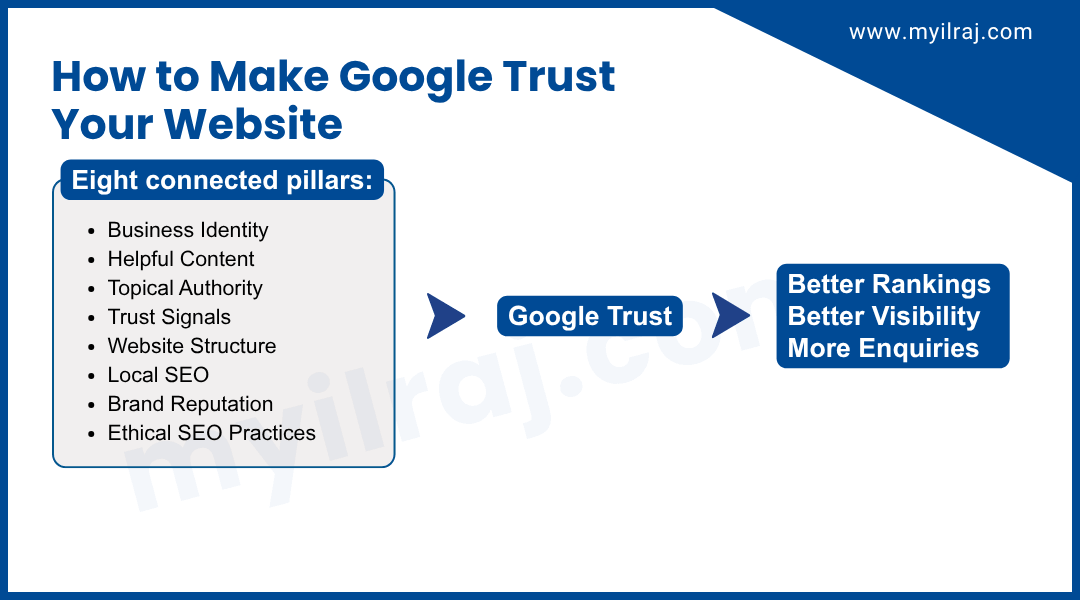
If Google doesn’t trust your website yet, don’t try to fix everything with one trick.
Trust is built through repeated signals. Your content, structure, identity, Local SEO presence, and user experience all must support your business.
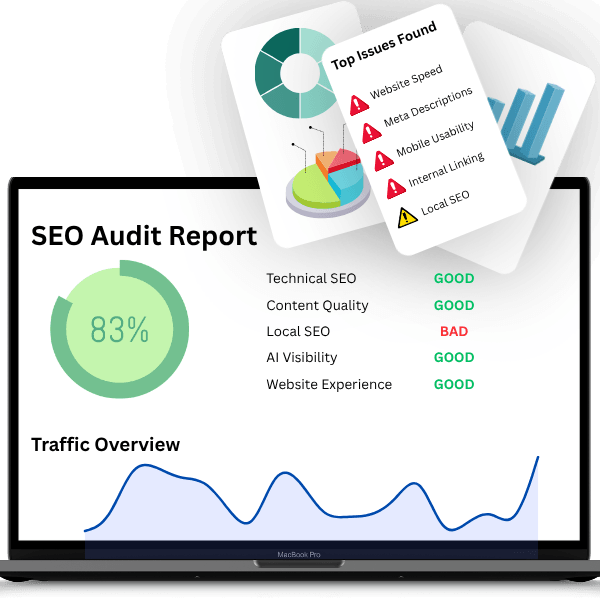
Let me share a recent website audit.
It is a Coimbatore-based service business website. I found 140 indexed pages, but no visible author bio, no Google Business Profile reviews in the last 6 months.
Further, I discovered many internal links between blogs and service pages. Their best money keyword was sitting at position 41.
Just imagine how Google and AI systems understand this website and start recommending it.
1. Publish Experience-Driven Content
Start publishing content that shows what you have actually seen, learned, tested, and solved.
Don’t write only general tips and explanations. Explain what happens on real business websites.
When I audit websites, I often see the same problem. The content is technically correct, but it has no real observation.
Experience-driven content builds confidence as it makes your readers feel, “this person understands my problem.”
This is how helpful content starts building trust.
2. Build Clear Topic Clusters
Writing only one blog will not make Google trust your website. You need connected content around your core business topics.
For example, if your main identity is an SEO Consultant in Coimbatore, your website should consistently cover SEO strategy, AI Search, and business discoverability.
Don’t jump into random topics only because they have search volume.
Create topic clusters to support your business positioning. When your content stays focused, topical authority becomes stronger over time.
3. Improve Author and Business Transparency
Your website should clearly show who is behind the content and business.
Add a proper author bio, founder story, About page, business address, and contact details.
Not only that, but add real photos, social profiles, and service clarity. If possible, show your experience, client type, working process, and why you are writing the content.
People trust people before they trust websites.
4. Strengthen Internal Linking
Internal linking helps Google and AI systems understand your website better.
Connect your blogs, service pages, guides, FAQs, and related articles naturally.
Always use clear anchor text and don’t use only “click here” or “read more.” Tell the reader what they will find after clicking.
In my experience, many websites have good pages. But those pages are not connected properly. Fix that issue today.
5 Improve Local Trust Signals
If you serve local customers, Local SEO signals are important. Optimize your Google Business Profile, add regular photos, and maintain NAP consistency.
Collect genuine customer reviews, create local landing pages, and publish service-area content.
Make sure that your website connects your business with your city, service area, and customer intent.
Strong local trust signals help Google understand where your business is relevant.
6. Update Content Regularly
Old content can slowly become weak if it is not updated. Review your important pages once in a while.
Add new examples, update outdated points, strengthen internal links, refresh images, and make the content more useful for today’s users.
I don’t suggest changing content randomly every week. When Google sees that your website is active, maintained, and improving over time, it sends a better quality signal.
7. Build Real Brand Presence
Google trust does not come only from your website. Your overall digital presence also matters.
Leverage LinkedIn, Google Business Profile, branded searches, and local citations.
When people see your content on LinkedIn, search your name on Google, and engage with your business, it supports brand credibility.
That is why I always say SEO and branding should work together.
A silent website will take a long time to build trust. But an active, visible, and helpful brand builds discoverability faster across Google Search, Google Maps, and AI search experiences.
If you have plans to hire someone for SEO or spend money on monthly services, take one step back and diagnose what is actually wrong.
Read my guide on diagnosing website problems before spending money on SEO to identify the actual SEO problem. Is it about a trust issue, or about other problems running alongside it?
What I Usually Check in a Website Trust Audit
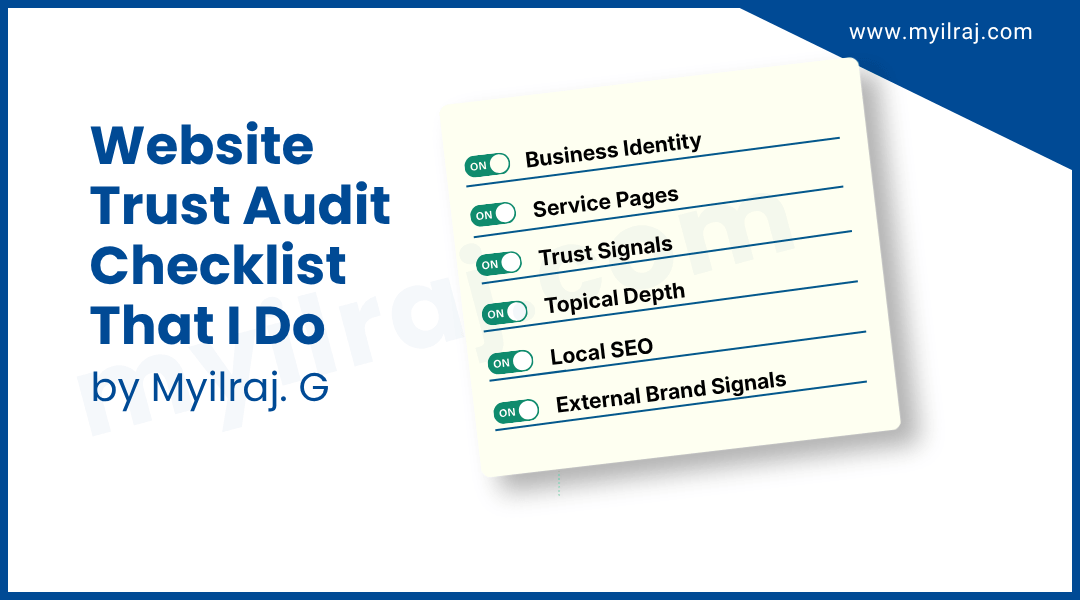
Whenever I audit a website trust, I don’t look only at rankings. I try to find whether the website gives enough reasons to trust the business.
First, I check the business identity.
- Is it clear who owns the business?
- Is the founder or author visible?
- Is there a proper About page, contact details, and business address?
Then, I check the service pages.
- Are they useful, clear, and connected to the customer’s real problem?
- Are trust signals visible?
- Trust signals like testimonials, reviews, client examples, case studies, and portfolio are a must.
At last, I look at topical depth.
- Does the website cover one clear business topic, or is it publishing random blogs?
- Are the important pages internally linked?
- Are blogs supporting service pages?
For local businesses, I check Local SEO signals.
- Is the Google Business Profile active?
- Are reviews updated?
- Are local landing pages, service-area content, and local photos present?
I also check external brand signals.
- Are people searching for the brand?
- Is there any LinkedIn activity?
- Are there any genuine mentions, citations, and social proof?
Finally, I check for wrong SEO practices like keyword stuffing, duplicate content, and spammy backlinks.
This kind of audit helps me understand one thing clearly: Does this website look trustworthy enough for Google to recommend and for users to contact?
Conclusion
Google trust is not one single ranking factor. It is the combined result of many small but important signals.
At last, your website needs helpful content, a clear business identity, and topical authority.
Pay attention to Local SEO strength, good user experience, and consistent brand signals.
When all things work together, Google gets more confidence to understand your website. Also, the users get more confidence to contact your business.
If your website is indexed but still not ranking or generating enquiries, don’t look at rankings alone.
Just ask: Does Google have enough reasons to trust my business online?
If the answer is no, your next step is not random blogging. Your next step is to improve website trust signals, SEO, content quality, service clarity, Local SEO, and brand credibility.
If you want to understand why Google doesn’t trust your website yet, you can explore my SEO consulting services.
- Request a website audit or book a consultation.
A proper audit can show what is missing and what needs to be fixed first.
FAQ: Why Google Is Not Trusting Your Website?
Lack of clear business identity, helpful content, and topical authority are the main reasons. Google may not trust your website if there are no strong trust signals, no Local SEO signals, and no external reputation signals.
It depends on your website quality, competition, content consistency, authority, and SEO strategy. New websites usually need time to build visibility and trust.
E-E-A-T helps Google evaluate whether content shows experience, expertise, authoritativeness, and trustworthiness. It is especially important for building content credibility.
Yes. Generic, thin, copied, or low-value content can weaken website trust. Regular publishing of this content makes it harder for Google to rank your pages strongly.
Improve content quality, show author identity, add testimonials, build topical authority, strengthen internal links, optimize Local SEO, and keep your website updated.