
Most website owners blame SEO when enquiries are not coming. But SEO is not always the real problem. Before spending money on SEO, content, or a redesigning a website, diagnose the actual issue first. The real problem could be unclear messaging, weak trust signals, poor local visibility, or a broken contact path. A proper diagnosis tells you exactly what to fix first and saves you months of wasted investment.
Many business owners like you today blame SEO if their website is not generating enquiries. I can understand your pain.
You have a good website, and you expect people to visit, understand your service, and contact you.
But when calls, WhatsApp messages, or enquiry forms don’t come, the first thought is usually, “Maybe I need SEO.”
But wait. You need to ask this question first: “How to diagnose your website problems before spending money on SEO?”
I have worked with business websites and blogs since 2013 taught me something different.
Sometimes the problem is SEO.
Sometimes it is not.
The issue may be poor messaging, weak landing pages, unclear service offers, or no trust signals.
Sometimes, a slow website experience, poor Local SEO, or even a broken enquiry path reduces your SEO efforts.
That’s why I am saying spending money on SEO before understanding the real problem creates more frustration.
Even though you publish more blogs, build more backlinks, redesign the website, or hire someone for monthly SEO, you will see little or no progress.
Before hiring an SEO person, let me teach you how you can diagnose your website problems logically.
You will learn to understand whether you really need SEO, a website audit, better messaging, Local SEO, or conversion improvements.
Why Guessing Is One of the Most Expensive SEO Mistakes?
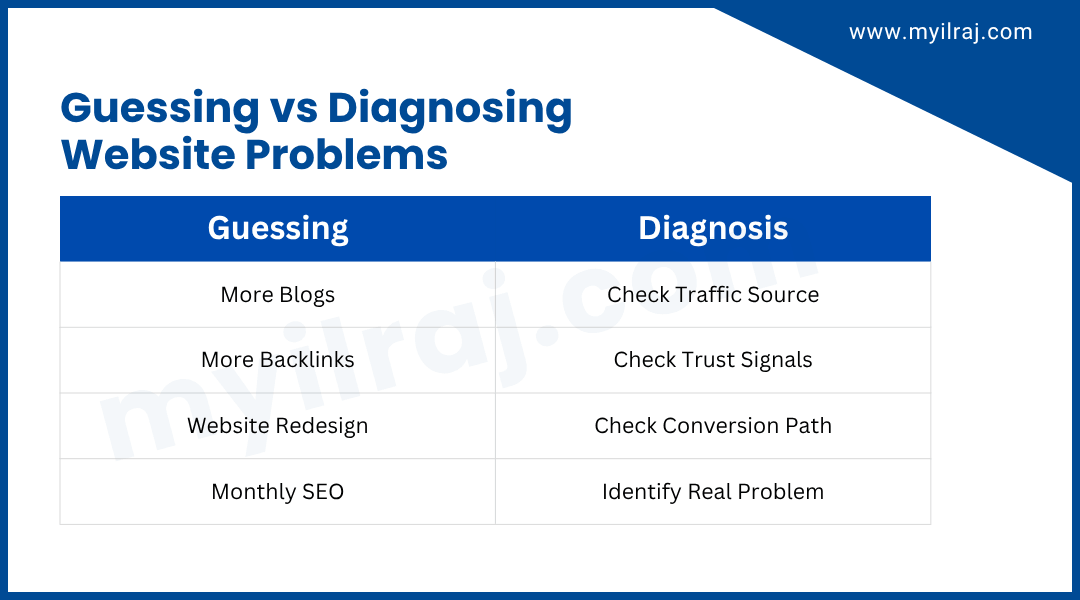
Guessing the SEO problem is the biggest mistake that every business owner makes today.
When enquiries are not coming, people usually assume things quickly.
- I need more backlinks.
- I need more blogs.
- My website needs to be redesigned.
- Google doesn’t like my website.
But these are only guesses. There is no proper evidence to back them up.
I have seen businesses spend money on blogs when their product or service pages were weak.
This is also why so many businesses struggle to rank on Google, even after months of SEO work; the real problem was never the content.
Some businesses redesign their entire website when the real problem was poor Local SEO.
A few business owners approached me asking for backlinks only to improve their rankings.
But in many cases, backlinks alone are not the reason. I have explained this clearly in my article on why your competitors rank higher on Google.
You will learn where the ranking gaps are connected with trust, topical authority, internal links, and user experience.
Now, coming back to the topic, this is why I say diagnosis should come before treatment.
Before hiring an SEO consultant or spending money on monthly SEO, first understand what is actually blocking your website’s growth.
Is it traffic?
Is it trust?
Is it a website conversion?
Is it a technical SEO issue?
Is it poor messaging?
Key Takeaway:
A proper website audit before SEO helps you avoid random spending and fix the right problem first.
Step 1: Identify the Real Business Problem First
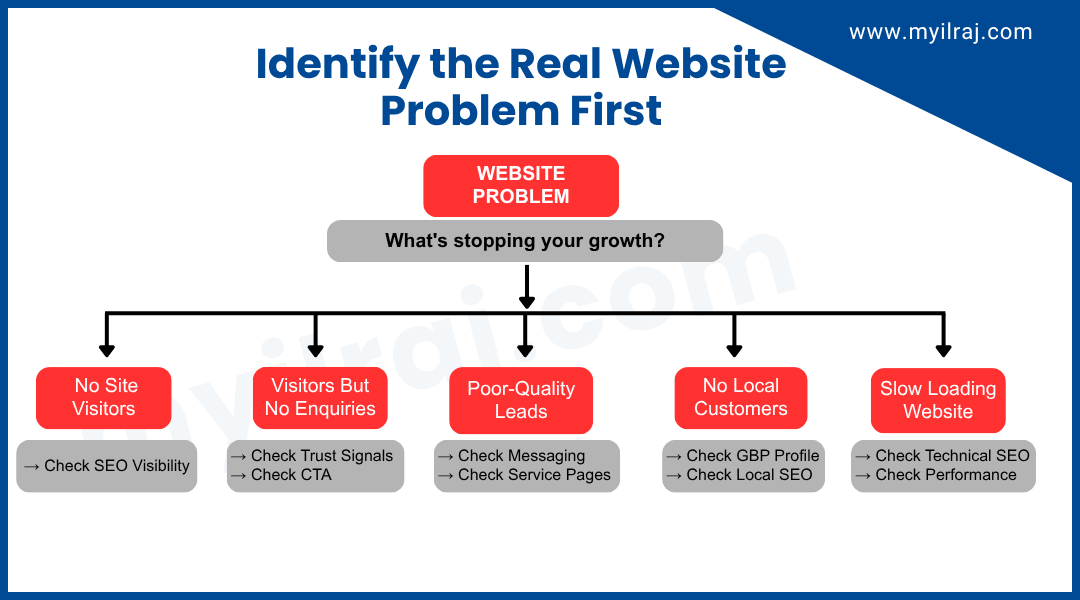
Before asking, “Do I need SEO?”, ask what is actually happening on your website at present.
Many business owners make the first mistake here. They directly jump to SEO without understanding the real business problem.
But I usually start with simple questions:
- Are you getting no visitors from different sources?
- People are visiting your website but are not sending enquiries.
- Your website sends enquiries, but they are poor-quality leads?
- Are you invisible on Google Maps?
- Do people land on your website and leave within a few seconds?
So, when you see above, each problem needs a different solution.
- If there are no visitors, the issue may be SEO visibility.
- If visitors are coming but not enquiring, the issue may be website conversion, trust, or CTA.
- If local customers are not finding you, your GBP profile has issues or local SEO problems.
Last year, I audited a home care product website built on WordPress. They spend money on SEO every month, but their product page has unclear messaging, which results in no orders.
Another business in a similar niche has decent traffic, but no proper enquiry path.
Key Takeaway:
Before spending money on SEO, diagnose the symptom clearly. Different symptoms need different treatment.
Step 2: Check These Yourself Before Spending Money
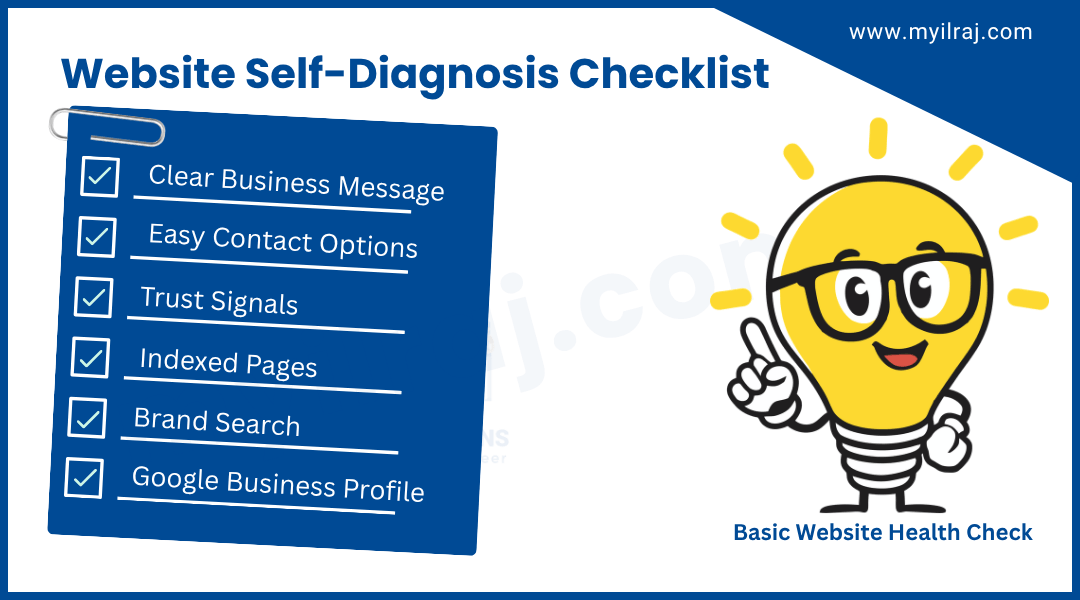
In this series, learn how to diagnose website problems before spending money, and do a few basic checks yourself.
You don’t need to be an SEO expert for this. All you need to do is look at your website like a new customer.
Many website problems become clear when you start looking at your website as a visitor.
One of the most important things in diagnosing a website is its Google discoverability. I have written a complete practical guide on why businesses invest in website but forget website discoverability.
This article will explain the exact meaning of Google online visibility or discoverability.
Let me share important points to check.
2.1. Can Customers Immediately Understand?
When someone lands on your website, they should understand your business within a few seconds.
Your visitors must know what you do, who you help, and what action they should take next.
If your homepage says something very broad like “We provide complete digital solutions,” the visitor may get confused.
Just compare these two messages.
Message 1:
We provide digital marketing services in Coimbatore.
Message 2:
We help Coimbatore businesses get more enquiries from Google Search and Google Maps.
I vote for the second message as it explains the audience, platform, and the outcome.
Many businesses today lose leads because their website does not communicate clearly.
Key Takeaway:
Before doing a website audit, check this first: can a new visitor understand your offer without scrolling too much?
2.2. Can People Contact You Easily?
Your website should not make people search for your phone number, WhatsApp button, or enquiry form.
The next step: make a call, WhatsApp, fill a form, or book a consultation must be easy.
Last year, I revamped three websites.
Those three websites have the same issue: the contact button is available only in the footer.
On mobile, the form is difficult to use, the phone number is not clickable, and the WhatsApp button is missing.
These small issues quietly affect website conversion.
For example, a local customer visiting your website from a mobile device wants to call immediately, and they should not struggle.
A visible call button or WhatsApp option can make a big difference.
Key Takeaway:
Before spending money on SEO, check whether your website gives people a simple way to contact you.
2.3. Does Your Website Build Trust?
People do not contact a business only because the website looks nice. They will contact you only when they feel safe and confident.
Your website should show enough trust signals. It may include testimonials, case studies, real photos, an About page, author details, and clear business information.
For example, I have seen websites with good service page content, but no real proof.
The website says, “we are experts,” but there are no client examples, no reviews, no photos, and no founder visibility.
So, it will create doubt, and visitors won’t go to the next step.
As a business owner, you may feel the website is complete. But as a visitor, they have a question, “Can I trust this company?”
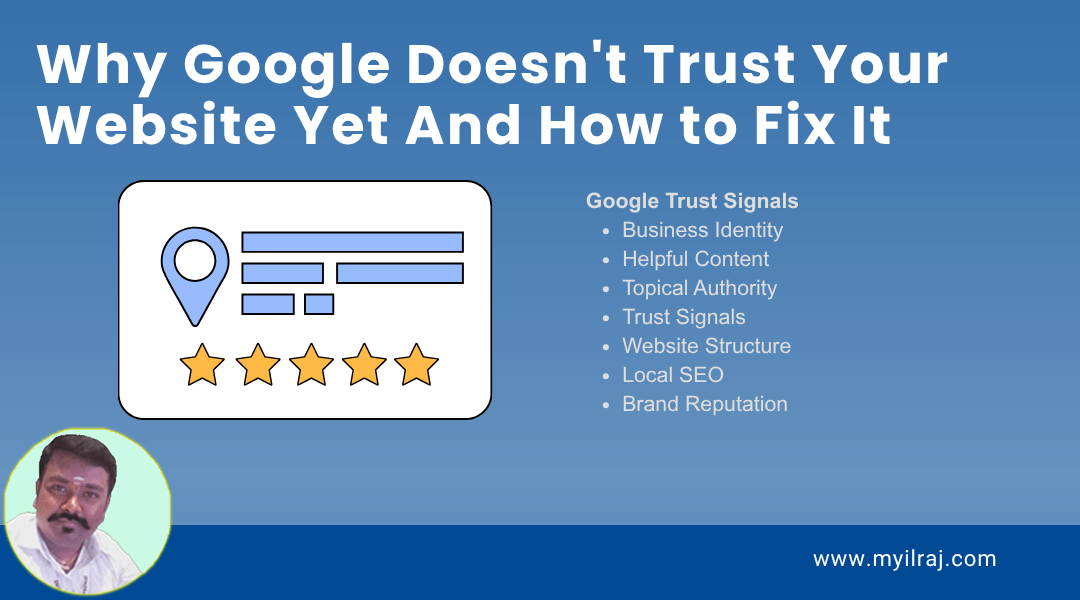
If you want to understand this deeper, I have explained the important website trust signals in another blog.
Read the blog once because trust is something that helps Google and users feel more confident about your business website.
Key Takeaway:
Before asking whether you need SEO, first check whether your website gives enough confidence to your visitors. If trust is weak, even good traffic may not become enquiries.
2.4. Are Your Important Pages Indexed?
Indexed means Google found your site and stored its pages in their system. If an important page is not indexed, it may not appear in Google search results.
Therefore, before spending money, check whether your key pages are indexed.
You can check this in your Google Search Console using the URL inspection tool.
You can also do a simple Google search like:
yoursite.com/page-url
For example, if your main service page is not indexed, publishing more blogs may not solve the real problem.
The issue may be a technical issue, meta no-index tags, crawl-related, or connected to page quality.
If your website’s important pages are not properly visible on Google, then there is no use in worrying about rankings.
Google’s own Search Central documentation says that a page must be indexed before it can appear in any search results. Thus, making indexing the most fundamental check before any SEO investment.
Key Takeaway:
During a basic SEO audit for business websites, check that your homepage, service page, blog posts, and contact page are indexed.
2.5. Search Your Own Business on Google
This is an important check on how to diagnose website problems before spending money.
- Search your business name on Google.
- Then search your main service.
- At last, search for your service with location.
Let me show you exactly how I apply this 3-step check to my own business.
When I search for my own business:
- My business name is “Raj Softech Solutions,” and it appears clearly on Google with the correct address and reviews.
- My primary service is “Search Engine Optimization,” and my website appears for “SEO Service” queries in the results.
- My target location is Coimbatore, and I specifically search for “Search Engine Optimization service in Coimbatore” to see whether my website or GBP profile appears on page 1.
If Google cannot connect all these three, “brand, service, and location,” then it is a visibility and branding problem, not an SEO content problem.
Now do the same for your business. Take two minutes to search your own business name, your main service, and your service + city. Whatever you cannot find easily is your first problem to diagnose.
People today search using local intent, like “SEO services near me” or “SEO service in Coimbatore.”
If your website and business profile are not aligned with those searches, you miss high-intent customers.
Key Takeaway:
If Google cannot connect your brand, service, and location clearly, it is an important website problem to diagnose.
2.6. Check Google Business Profile If You Are Local
Google Business Profile is very important if your business depends on local customers.
Open your GBP profile and check your business name, address, and phone number first.
Then, verify the phone number, website links, categories, services, working hours, reviews, and related photos.
Every month, I witness at least 10 businesses with decent websites but weak Google Business Profiles.
They don’t add photos or collect reviews. This affects local SEO and retard customer trust.
For example, a customer searching for “website design company near me” may choose your business.
Only if you have better reviews, active photos, and complete business information, even if your competitor has a better website.
Key Takeaway:
If your business targets local customers, don’t check your website only. You need to check your Google Business Profile, too.
When Website Problems Go Beyond Basic Self-Diagnosis?
Some website issues are easy to check yourself. But some problems need deeper SEO experience.
Let me share some examples;
Scenario 1: If your website rankings suddenly disappeared, stop guessing.
Check for indexing issues, crawl issues, technical SEO issues, or content quality problems.
Scenario 2: If important pages are not appearing on Google, stop guessing.
Check Search Console, sitemap status, meta robots, and robots.txt settings, and page quality.
Sometimes the issue is not visible from the front end.
Let me list some of them;
- Google Core Web Vitals score,
- Internal links proximity and network,
- Two pages may compete with each other,
- Structured data (a.k.a schema) may be missing or wrongly added,
- AI visibility gaps when your content is not clear, structured, or trustworthy enough.
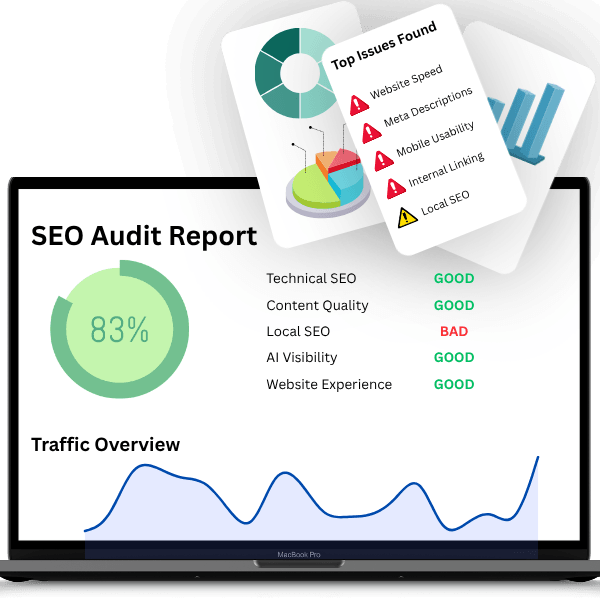
Here, you need a professional SEO audit for your business website.
A professional SEO website audit does not just list what is wrong. It tells you what to fix first, what can wait, and whether monthly SEO is actually what your business needs right now.
However, you don’t need to become an SEO expert. You only need to know when the problem is beyond simple checking.
Key Takeaway:
A proper website audit SEO helps identify where the real issue is, what should be fixed first, and whether SEO investment is actually needed.
When a Professional SEO Audit Actually Makes Sense?
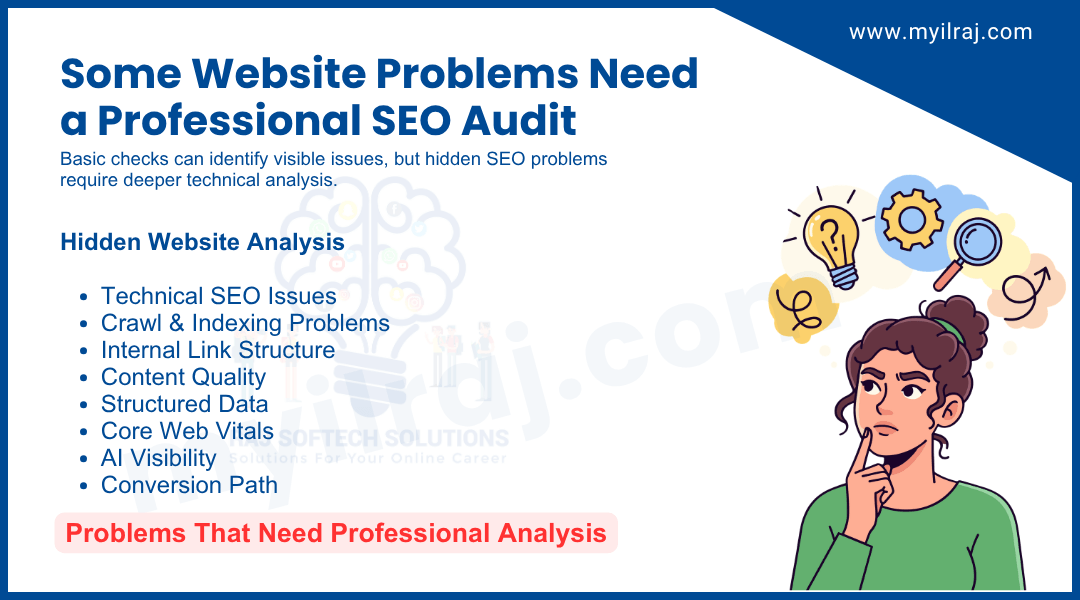
A professional SEO audit is needed when the problem is not visible from the outside.
You have already checked your website clarity, contact options, trust signals, and Google visibility.
However, you cannot understand what is wrong. Then, guessing further may waste more money.
You may be stuck on how to diagnose website problems before spending money. This is where an SEO audit for a business website becomes useful.
A professional audit helps you to identify the issues that are related to technical, content, local, structural, or conversion-based.
Here’s a simple guide:
| Situation | DIY SEO Check | Professional Audit |
| Unsure why the website is not ranking | No | Yes |
| No enquiries despite the traffic | No | Yes |
| Website redesign planned | Sometimes | Yes |
| Local rankings dropped | No | Yes |
| Business just launched | Sometimes | Sometimes |
| Important pages not indexed | No | Yes |
| Competitors ranking above you | Sometimes | Yes |
If your website is newly launched, I recommend starting with my complete guide on SEO for new websites. It covers exactly what to do in the first 30 days before spending on anything else.
From my personal experience, a business owner needs an SEO audit only when they have already tried basic fixes.
Key Takeaway:
A website audit before SEO gives clarity. It tells you what to fix first, what can wait, and whether SEO is actually the right investment at this time.
What Happens During My Manual SEO Audit?
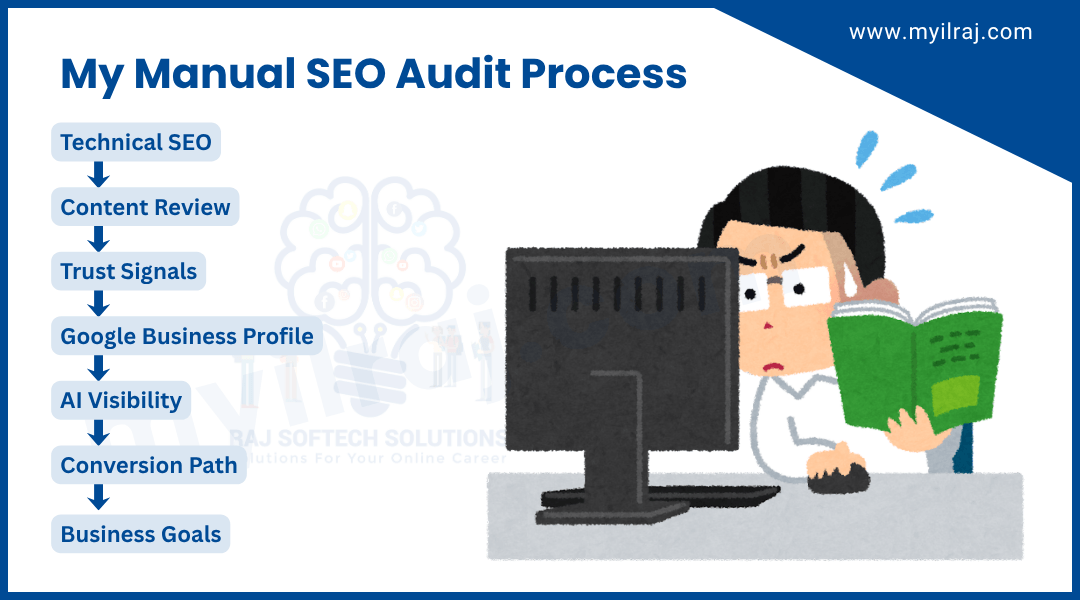
When I do a manual SEO audit, I don’t start by saying, “You need SEO.”
I will try to understand what is actually happening with the website and business.
First,
I will check technical SEO to see whether Google can crawl, index, and understand the important pages.
After this, I review content quality, service page clarity, internal links, and ensure the website answers real customer questions.
Second,
I look for trust signals. Trust signals like testimonials, case studies, real photos, portfolios, author details, business address, and proof of experience.
If the business targets a local audience, I check Google Business Profile, reviews, location relevance, local pages, and Google Maps visibility.
In 2026, I will also review for AI visibility,
Because search is evolving. Every piece of content should be clear, structured, useful, and easy for AI systems to understand.
At last,
I observe the conversion path.
- Are CTAs visible?
- Can people quickly call, WhatsApp, or send an enquiry?
- Is the website guiding visitors properly?
Finally, I connect every dot back to the business goals.
If you want to understand the full process before deciding, you can read more about how I work as an SEO Consultant in Coimbatore.
Key Takeaway:
The purpose of an audit is simple: Find what is working, what is blocking growth, and what should be fixed first.
Why I Don’t Believe Every Business Needs Monthly SEO?
Every business does not blindly need monthly SEO. Sometimes those websites do not need more blogs, more backlinks, or more SEO activity.
All it needs is better messaging, stronger service or product pages, clearer service offers, and stronger internal links.
A few businesses are spending on SEO every month when their enquiry form is weak, or their service page is unclear.
In such cases, monthly SEO may not solve the real problem.
So, it is important to learn how to diagnose website problems before spending money on SEO.
First, understand what is blocking the website. Then decide whether the business needs SEO, a website audit, or content restructuring.
Good SEO is not about doing more work blindly. It is about doing the right work in the right order.
Now you have learned how to diagnose your website problems before spending money on SEO. It helps you decide whether SEO, a redesign, or simply better messaging is what your business actually needs.
Still, are you unsure what is holding your website back? A manual SEO website audit can help you here.
You can see what is working, what is limiting your ability, and what should be fixed first.
FAQ: How to Diagnose Website Problems
Yes, you can diagnose basic website problems. Start from your website message, contact options, important pages index status, trust signals, and Google Business Profile.
If your website has low visibility, poor rankings, indexing issues, weak internal links, or very little organic traffic, SEO is the real problem. If the visitors are coming, but no one is enquiring, the issue may be in the conversion funnel, trust, or messaging.
An SEO audit helps you identify what is wrong with your website and what should be fixed first. SEO services are the ongoing work done after diagnosis, such as content, technical fixes, internal linking, speed optimization, and Local SEO.
Redesigning a website is not always required. First, identify the problem, whether it is related to design, content, trust, speed, structure, or SEO. Website redesigning with proper diagnosis can repeat the same mistakes in the new layout.
A professional website audit cost varies based on website size, business goals, technical issues, and audit depth. I charge from Rs. 5000 onwards, and the report gives clear findings, priorities, and action steps.
AI tools can help find basic issues. They cannot fully replace a manual SEO audit. A manual SEO audit connects SEO data, business goals, user intent, trust signals, and conversion problems.