
Every day, I am seeing businesses struggle to rank on Google. If you have created a website in 2026 and expect people to enquire about your business, it will not happen.
Just having a website alone will not get you visibility on Google. Many businesses regularly publish blogs, update service pages, and even stay active on social media.
But they still struggle to rank on organic search results. A big frustration for business owners trying to grow online.
They have invested time, effort, and money into creating blogs for their websites. But organic traffic remains low, and inquiries do not improve.
However, their competitors continue to dominate the Google Search, Google Maps, and AI Overviews.
I want to let you know that the SEO has changed significantly in recent years. Google is no longer ranking websites only based on Keywords or the number of published blogs.
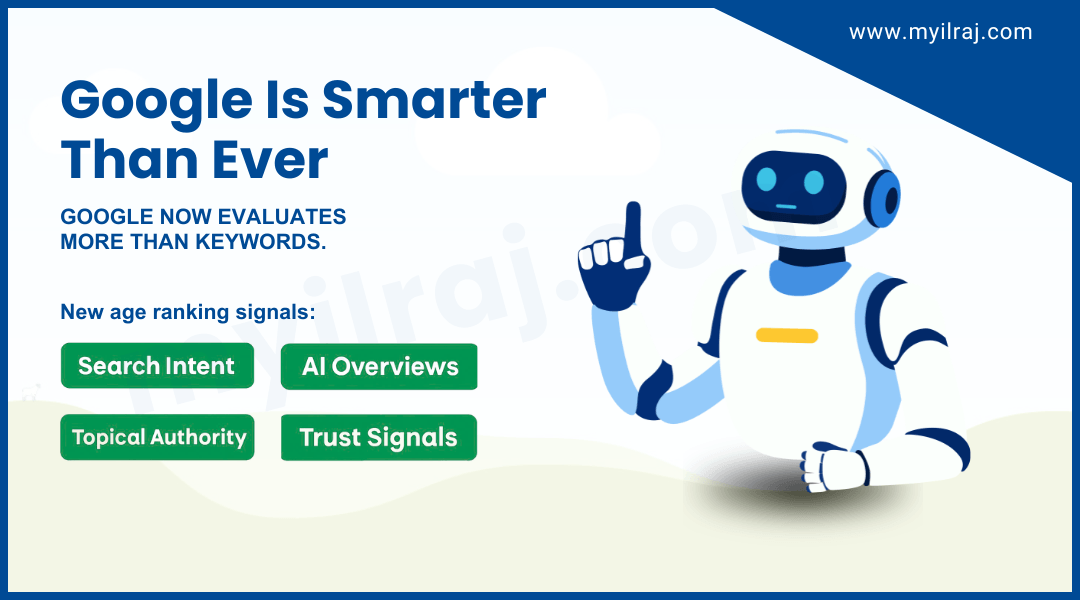
Search Engines and AI look for topical authority, search intent, content quality, user experience, trust signals, and overall business credibility.
Algorithms become smarter with the rise of AI overviews in 2026. Businesses need to strategize their SEO rather than random publishing.
If your website is not visible on Google, it does not mean that your offer poor services. The only reason is that Google still doesn’t fully understand you and your business.
Google fails to realize your authority, relevance, and niche expertise. Hence, your first step is to understand these changes and create a sustainable organic growth plan.
1. Google Is Smarter Than Ever in 2026
I always say one thing to every business owner: Google is very different in 2026 from what it was a few years ago.
Before 2023, if you published a blog with keywords and a few backlinks, Google would rank your website.
But today, Google wants to understand your website’s user behavior, search intent, content quality, and your business credibility (more deeply).
If your website is not ranking on Google, it does not mean your SEO is bad. Sometimes, Google fails to understand your website enough or does not trust you.
1.1. Search Intent (Is More Important Than Just Keywords)
Even today, several businesses think SEO is about finding keywords and inserting them into blogs or service pages.
In 2026, Google focuses heavily on user search intent.
In simple words,
- Google is trying to understand why someone is searching for your product or services.
- Whether the person is looking for information or comparing your product or services.
- Is the person ready to purchase or just exploring the options on your website?
For example,
Someone searches for “SEO Consultant in Coimbatore.”
Before 2023, Google ranked pages based only on the keywords and content length.
But today, Google will rank your website only if it genuinely answers the user’s need.
Google will check,
- Does your page explain the SEO process clearly?
- Does it build trust?
- Does your content speak to your experience?
- Does your website help visitors make a decision?
Several businesses in SEO and Digital Marketing struggle with Google rankings, even after publishing 100s of blogs.
When you read their blogs, they were purely written for search engines, not for real users. I have explained this in detail in my guide on SEO for New Websites.
If you solve this problem, you can easily rank your website in 2026.
1.2. AI Overviews (Changes How Businesses Get Visibility)
Every SEO and business talks about this AI overview feature in Google Search. Nowadays, Google summarizes information directly on the search result pages.
List websites in the order section goes below the visible area of our computer or laptop screen. It means people get their answers before they even click your website.
These days, businesses are no longer competing only for rankings. They are competing for visibility inside these AI-generated summaries.
It’s not simple to be cited by AI. Generic blogs written without real experience or strategic depth are becoming less useful.
These AI systems prefer only insightful, structured, experience-driven, and trustworthy content.
My Suggestion:
Businesses should stop creating blogs only for traffic.
Instead, they should focus on becoming a reliable source of information in their niche.
How to rank in AI overviews?
- Explain the topics clearly with deep insights.
- Share your practical experience in every content piece.
- Make readers realize that you are a real person behind the screen.
- Publish relevant content consistently to dominate modern search experiences.
Follow those tips above to win AI overviews.
1.3. Topical Authority (Matters More Than Publishing a Blog)
Many businesses publish random blogs every week because they want to push all keywords in their list. This is the worst mistake I see very often.
Google, in 2026, is giving more importance to topical authority over KW-rich content.
What is Topical Authority?
It means you should help Google to understand what your website is known for. It is an SEO strategy where your website is a go-to source of expert advice on a specific topic.
For example, this website (myilraj.com) consistently talks about SEO strategy, Local SEO, Google Visibility, and AI Search Implementation.
Over time, Google slowly starts associating your brand with those topics.
But if you publish a blog about SEO this week, social media strategy next week, and then digital marketing.
Google receives mixed signals, and your website may struggle to build strong authority. At last, your website fails to rank.
My Recommendation: Always focus on structured content clusters rather than random topics.
I also discussed how businesses can choose the right SEO approach. Read this comparison article on SEO Consultant vs SEO Agency in India.
A clear SEO strategy helps search engines understand your expertise. This process gradually improves your website’s ranking, visibility, and long-term organic growth.
Sometimes, you may be wondering how your competitors stay ahead of you. Your competitor may be winning not just because of better keywords.
Their entire website gives Google more confidence than you. See why competitors rank higher than your website for a detailed comparison.
1.4. Trust Signals (A Major Google Ranking Factor)
Google almost stopped ranking based on keywords and content length. Trust is the most important ranking factor in 2026.
Businesses operating in competitive industries such as SEO, healthcare, finance, consulting, and professional services require special care.
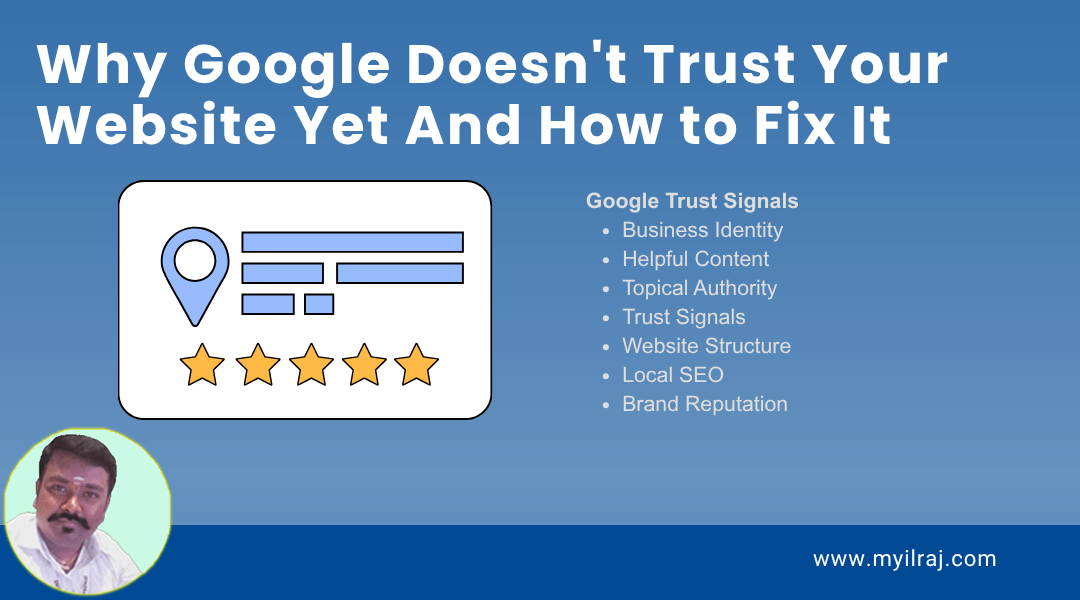
What are Google’s Trust Signals?
- Consistent branding across digital platforms.
- Clear author information in every blog.
- Client-focused content that solves a real user problem.
- Transparent business contact details with social media presence.
- Your website’s user engagement metrics, such as bounce rate, user on time, etc.
- Reviews and testimonials about your product or services.
- Proper website structure (internal linking, etc.)
- How people interact with your brand on platforms such as LinkedIn and Reddit, etc.
It is a fact that businesses do not rank only because they have a website. They will rank only when Google starts trusting them over time.
And the trust will not come overnight; it builds gradually through consistency, useful content, strategic SEO, and strong business positioning.
If you still have doubts about whether your current SEO efforts are actually helping your website, learn how to check if SEO is done properly.
In Short:
If your website demonstrates expertise, experience, and clarity, Google will trust you strongly.
2. Most Businesses Still Treat SEO Like a One-Time Task
Even today, many businesses see SEO as a one-time setup or a checklist to fulfill. To be frank, SEO is not like that.
Moreover, they invest in website design and add a few service pages and 2 or 3 blogs. Then do some basic On-page SEO things and wait for Google rankings and organic traffic.
In real-time, Google never cares about such websites and will not consider them for ranking. Modern-day SEO does not work in this way.
For every client I talk to, I will explain:
Developing a website alone will not build Google visibility.
SEO is not a “set it once and forget it” system.
These days, due to increased competition, Google and AI systems evaluate websites for freshness, consistency, topical relevance, user engagement, and trust signals.
If you stop updating your website content, improving pages, or strengthening its online presence, competitors will take your ranking.
Sometimes, businesses publish random blogs for one month, then disappear, and then publish again. This inconsistent activity sends a weak signal to Google.
Strong SEO in 2026 must be;
- Building topical authority consistently,
- Improving website structure and user navigation,
- Publishing helpful content around their business,
- Strengthening discoverability across all platforms.
When you stay consistent even when there are no results, you will see considerable growth over time.
3. Weak Website Structure Confuses Google
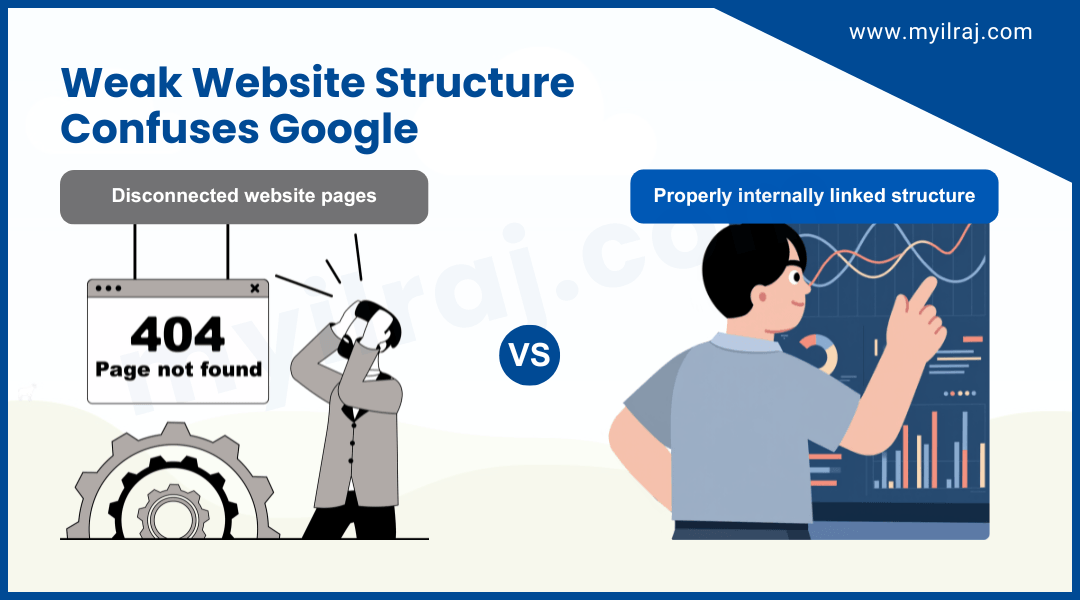
Another problem why businesses struggle to rank on Google is their weak website structure. The website may look visually awesome, but its structure confuses Google.
In 2026, though the visual appearance contributes to our organic growth, a clear structure plays a major role.
A properly structured website helps search engines understand your business, services, and expertise clearly.
A recent example;
I reviewed a digital marketing agency website from Pune. Their homepage talks about SEO services and Website design services.
They have 20+ individual pages talking about all digital marketing services. They even publish blogs on those topics every other day.
In the end, from Google’s perspective, the website lacked clarity and topical connection.
From our point of view, we provide all digital marketing services, and it is acceptable.
However, Google’s point of view is different.
Poor navigation, weak internal linking, and disconnected pages make it difficult for search engines to understand which pages are important.
If Google can’t realize or understand your primary service, rankings will be a nightmare.
We must connect related pages properly to help Google and AI systems understand our topical authority.
4. Thin Content Is One of the Biggest Ranking Problems
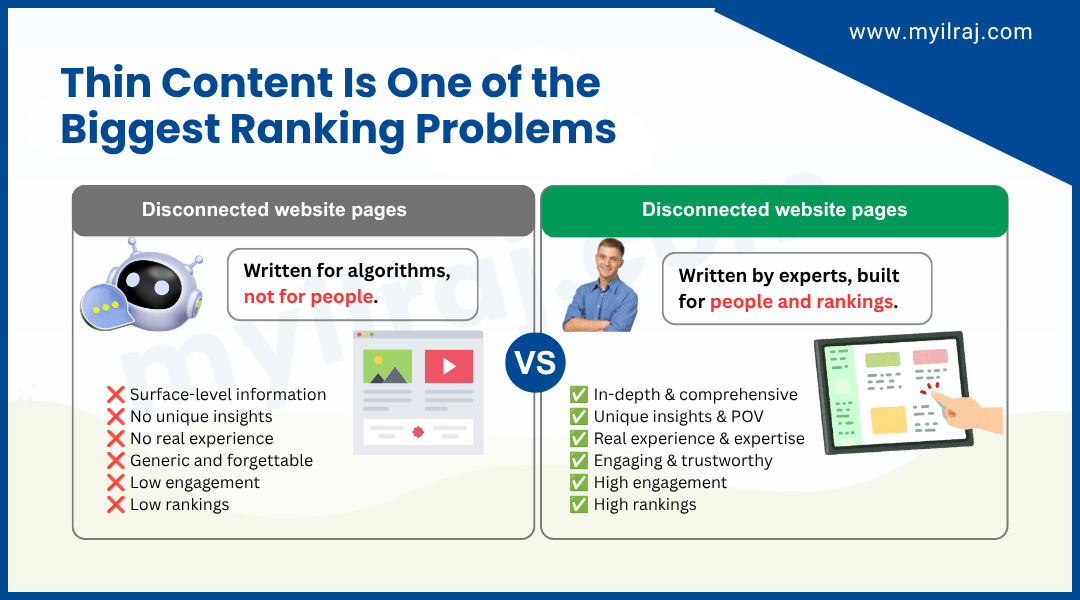
I see businesses consistently publishing blog after blog. Some businesses publish a blog every day. But when you read that content, they feel generic, shallow, and written only to fill space.
They leverage AI tools to write blogs in bulk without any real experience, practical insights, or strategic value. On the other side, Google has become much smarter at identifying such AI-written, thin content.
Every time I say this to my clients,
AI can help with content production, but it cannot replace real-world expertise and experience.
AI just aggregates content that is already available on the Internet. If your blog sounds similar to hundreds of other articles, it will fail the Google ranking evaluation test.
Because Google has no strong reason to rank your blog higher. No experience, no depth, and no EEAT are the primary reasons.
Modern-day SEO depends heavily on EEAT – Experience, Expertise, Authoritativeness, and Trustworthiness.
For example,
If your business shares real client experiences, practical observations, or real SEO challenges, your content will become stronger.
People will trust your website as it has more depth than word count.
Next time, stop writing long content; instead, write experience-driven content with a clear structure.
When you do so with strategic intention, Google and AI systems will never avoid ranking your website.
5. Businesses Ignore Local SEO Signals
People’s search behavior has changed, and they look for businesses that are easily reachable in person.
In cities like Coimbatore, Chennai, and Madurai, businesses focus only on website design and ignore Local SEO signals.
But in 2026, local intent is a game-changer as Google and AI try to show nearby, highly relevant businesses.
The results purely based on the user’s location, past search behavior, and trust signals.
I hope you know about Google Maps and its top-3 local map pack visibility, which plays a major role in business discoverability these days.
For example,
Let’s assume someone searches for “SEO consultant in Coimbatore,” or “digital marketing agency near me.”
Google will not list websites randomly. It will look for other SEO factors like Google Business Profile Optimization, location relevance, reviews, and consistent business information.
Many businesses struggle to rank on Google because they ignore these foundational local SEO elements.
Remember, in this year, Local SEO is no longer optional for businesses. Even if you serve globally, your website will remain invisible if Google cannot connect your business with local search intent.
So, dig your Google business profile, update it with the latest information, and optimize it for Google Maps presence.
If possible, add location pages and include a local content strategy to create stronger visibility, trust, and lead generation.
6. SEO Without Branding No Longer Works
Another major shift that I personally observed this year is that SEO without branding is becoming weaker. That’s why many businesses struggle to rank their website on Google.
A few years back, you could easily rank your website by targeting keywords and building backlinks.
However, these days, Google pays more attention to brand signals, online presence, and overall discoverability.
This is why businesses invest in branding along with their SEO activities.
After you put your website live on the Internet, you need to create a social media presence for your brand.
LinkedIn presence, active Reddit participation, Pinterest posts, and Quora indirectly strengthen your SEO performance.
Just imagine, people search specifically for your business name, your services, or even your personal brand.
Google begins recognizing your business as it has its own authority and trust.
For example,
I run my organic digital marketing agency named Raj Softech Solutions India Private Limited.
I regularly share practical insights, knowledge, case studies, and SEO work experience on LinkedIn, Instagram, Facebook, and Twitter.
People start engaging with my content, visiting my website directly, and sometimes, searching the brand name on Google.
These trust-building signals improve my organic discoverability naturally.
Nowadays, Google rewards businesses that people genuinely recognize, engage with, and trust online.
7. Many Businesses Expect SEO Results Too Fast
I want to clear one thing about SEO.
- Indexing is not the same as ranking.
- Rankings are not the same as leads.
In 2026, even if you regularly publish blogs, you cannot expect immediate Google rankings within weeks.
Many business owners feel this way and assume SEO is not working.
We need to give some time for Google to crawl, understand, evaluate, and trust our website. Initially, it will take 3 to 4 months, but for a grown brand, it will happen in weeks.
Even if your blog pages get indexed, it has to compete with websites with stronger authority, better content depth, and years of trust signals.
- SEO is a slow and gradual process of improving your organic visibility and online presence.
Even if your website is ranked better and gets 1000s of daily visitors, you may see fewer or zero enquiries.
Modern-day SEO works when user intent, trust building, and content strategy work together.
If this sounds familiar, read my detailed guide on why businesses are not getting leads from Google even when traffic is coming in.
Businesses that understand the long-term nature of SEO usually build stronger, more sustainable organic growth over time.
8. AI Search Is Changing How Businesses Get Discovered
Today, search is no longer limited to traditional Google rankings alone. AI overviews, semantic search, AEO, and GEO give a new life to SEO.
Google nowadays tries to understand the meaning, context, and relevance of your blog posts.
Modern-day SEO is moving towards structured, experience-driven, and contextually relevant content.
If your website clearly explains your services, answers real user questions, and maintains strong topical relevance, you can rank better.
Google and AI systems can understand your business more effectively.
Structured content plays a huge role here. It means;
- Proper headings,
- Internal linking,
- FAQs,
- Schemas,
- Images,
- Semantic relevance.
These elements help search engines connect related topics on your website more intelligently.
Today, if you adapt to AI search optimization and GEO SEO strategies, you can easily rank.
They are the future-proof digital marketing strategies to build your digital authority.
Why Is My Website Not Ranking on Google? Reasons and Solution
If your website is not ranking on Google, it does not always mean that Google has ignored your business. In most cases, Google has not found enough strong signals to rank your page above others.
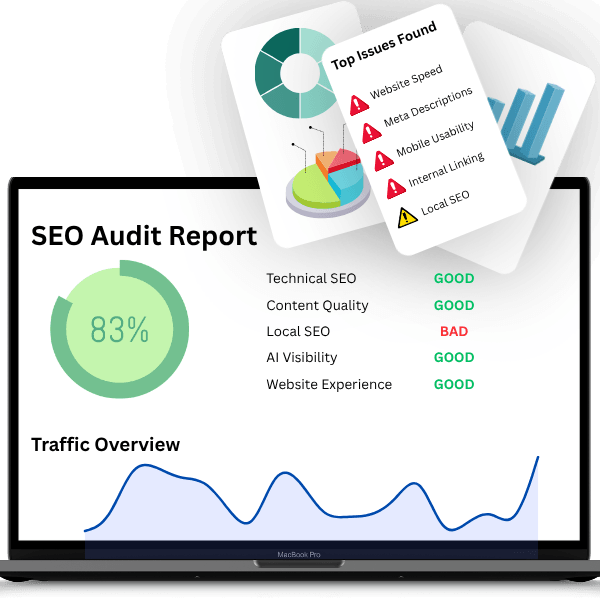
In my recent website SEO audits, I saw that the website has indexed pages, but the content was thin. The service page exists, but it fails to match search intent.
The blogs are published, but do not support the main service pages. Moreover, the website has weak internal links, poor local SEO signals, no clear trust proof, and very little topical authority.
Now, ask this question to yourself, “Does my website give Google enough reasons to rank it?”
Check these first:
- Is the page indexed?
- Does the page answer the search clearly?
- Is the content better than competitors?
- Are internal links pointing to the page?
- Does the website show trust signals?
- Is Local SEO properly optimized?
- Is the page mobile-friendly and easy to use?
The solution is not redesigning the website or random blogging.
You should start by improving content quality, search intent match, internal linking, trust signals, Local SEO, and user experience.
Even after rankings improved, many businesses still cannot identify what is actually holding them back.
If you are unsure whether SEO is the real problem, learn how to diagnose your website problems before spending money on SEO.
What Businesses Should Focus on Instead?
In 2026, businesses that rely on outdated SEO strategies or random content publishing will struggle to rank on Google.
Search becomes smarter, and you need to focus on these areas instead.
Topical Authority: Focus consistently on topics that are directly related to your core business expertise and customer search intent. Do not try to behave smartly.
Content Clusters: Stop publishing random blogs. Instead, build connected blogs and service pages around your core service or product.
Local SEO: Optimize your website for local search and optimize Google Maps, location pages, and services or products to improve nearby business visibility.
Consistent Publishing: Create a schedule to publish high-quality, helpful blogs with experience-driven content regularly (not just randomly).
Internal Linking: Connect relevant blogs with their relevant service pages to help users and Google understand your website structure better.
User-Focused Content: Do not write everything in your blog. Pay attention to creating content that genuinely solves business problems in real-time. Do not just write for search engines.
Conclusion
We are in the AI-driven search experiences period, which is growing rapidly. Trust signals play a huge role in building your online visibility.
If you engage in building topical authority, strengthening discoverability, and improving Local SEO, you can dominate Google and AI.
Always promise yourself that you will publish only experience-driven, helpful content that helps people solve real-time issues.
SEO today is not just about rankings based on keywords and backlinks. It is a process of building trust, authority, and long-term discoverability across multiple search experiences.
Once you understand why your website is struggling to rank, the next question becomes, why is your competitor ranking above you? I have explained the exact signals Google compares in my guide on why competitors rank higher on Google.
If your business is struggling to rank on Google or generate consistent organic visibility, it’s time to rethink your SEO strategy.
Explore my SEO consulting services or book a consultation today. I will help you understand your business scope and suggest ways to improve your online discoverability in 2026.
FAQ: Why Are Websites Not Ranking?
Businesses struggle to rank on Google because of their weak SEO strategy, thin or AI-written content, and poor website structure. Not only that, but other primary reasons like a lack of topical authority and inconsistent publishing also prevent you from ranking your website.
SEO is a continuous and long-term process. Usually, it takes 3 to 5 months to see some noticeable improvements in ranking. However, the time may change based on the competition, website quality, and consistency.
It is a process of letting Google and AI systems understand your expertise in a specific subject or industry. For example, I am consistently talking about AI SEO, Local SEO, and Google Visibility. Google is slowly starting to trust my website more for SEO-related searches.
Doing Local SEO helps your business improve visibility in Google Search and Google Maps for nearby customers. Because people trust businesses with a local presence. Therefore, optimizing local SEO signals can improve discoverability and website traffic.
Yes, AI-generated content can rank on Google only if it is helpful, well-structured, and experience-driven. Generic AI-written blogs without expertise, depth, and experience usually struggle to perform well.
Google will not rank your website that has little or no relevance, trust, content depth, or user experience. Other reasons that your website fails to rank are poor internal links, few local SEO signals, and no fresh activity.